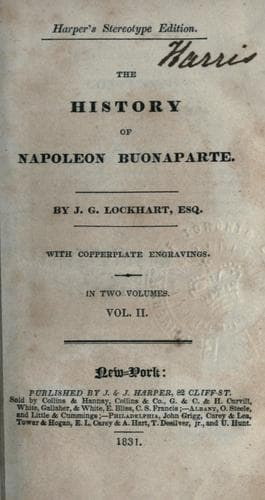
The History of Napoleon BuonaparteLockhart, J. G. (John Gibson)
History
The History of Napoleon Buonaparte
Lockhart, J. G. (John Gibson)
France -- Kings and rulers -- Biography; Napoleon I, Emperor of the French, 1769-1821
The irregularities of all this procedure were monstrous. In the first
place, the duke owed no allegiance to the existing government of France.
2ndly, The seizure of his person was wholly illegal; it took place by
means of a violation of an independent territory: an outrage for which
it is impossible to offer the smallest excuse. 3rdly, Had the arrest
been ever so regular, the trial of a prisoner accused of a political
conspiracy was totally beyond the jurisdiction of a court-martial.
4thly, It was against the laws of France to hold any trial at midnight.
5thly, The interrogatory was not read over to the prisoner, which the
law imperatively demanded; and, 6thly, No defender was assigned to
him--an indulgence which the French code refuses not to the meanest or
most atrocious criminal, by what tribunal soever he may be tried.
But to proceed--The judges were moved by the conduct of the prisoner,
and inclined to listen to his request of an audience of the Chief
Consul. But Savary, then minister of police, had by this time introduced
himself into the chamber, and watched the course of procedure from
behind the chair of the president. He now leaned forward, and whispered
into Hullin's ear, "this would be inopportune."--These significant words
were obeyed. The court pronounced the duke guilty of the capital crimes
of having fought against the Republic; of having intrigued with England;
of having maintained intelligence with Strasburg, with the view of
seizing that place; and of having conspired against the life of the
Chief Consul. The prisoner, being remanded to his confinement, the
report was instantly forwarded to Buonaparte, with a request that his
further pleasure might be made known.
The court remained sitting until their messenger returned: he brought
back their own letter with these words inscribed on it, "Condemned to
death." The prisoner being called in again, heard his sentence with
perfect composure. He requested the attendance of a confessor, and was
answered,--"Would you die like a monk?" Without noticing this brutality
he knelt for a moment, as in prayer, and rising, said, "Let us go."
He was immediately led down a winding stair by torch-light; and,
conceiving that he was descending into some subterraneous dungeon, said
to one of the soldiers of the escort, "Am I to be immured in an
_oubliette_?" "Monseigneur," the man replied, sobbing, "be tranquil on
that point." They emerged from a postern into the ditch of the castle,
where a party of gens-d'armes d'élite were drawn up, Savary, their
master, standing on the parapet over them. It was now six o'clock in the
morning, and the gray light of the dawn was mingled with the gleam of
torches. The prince refused to have his eyes bandaged--the word was
given, and he fell. The body, dressed as it was, was immediately thrown
into a grave--which had been prepared beforehand; at least, so say all
the witnesses, except M. Savary.
Public-domain text, read in full here on John Shaqi.
Reviews
Reviews
No reviews yet
Be the first to share your thoughts on this work.
Elsewhere in the archive
Join the Discussion
Join the discussion
Sign in to leave a comment or review.
Sign InorCreate an account