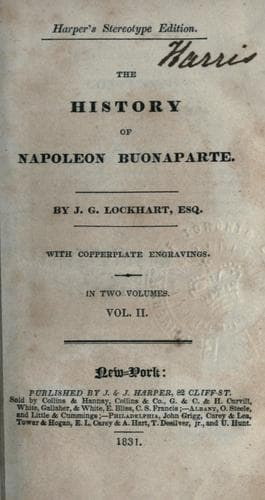
The History of Napoleon BuonaparteLockhart, J. G. (John Gibson)
History
The History of Napoleon Buonaparte
Lockhart, J. G. (John Gibson)
France -- Kings and rulers -- Biography; Napoleon I, Emperor of the French, 1769-1821
The battle commenced at ten in the morning, and the Russians stood their
ground with unbroken resolution until between four and five in the
evening; sustaining numberless charges of foot and horse, and exposed
all the while to a murderous cannonade. At length Napoleon put himself
at the head of the French line, and commanded a general assault of all
arms, which was executed with overpowering effect. Having lost full
12,000 men, General Bennigsen was at last compelled to attempt a
retreat; the French poured after him into the town: the first Russian
division which forced the passage of the river destroyed the bridge
behind them in their terror; and the rest of the army escaped by means
of deep and dangerous fords, which, desperate as the resource they
afforded was, had been discovered only in the moment of necessity.
Nevertheless such were the coolness and determination of the Russians,
that they saved all their baggage, and lost only seventeen cannon; and
such was the impression which their obstinate valour left on the enemy,
that their retreat towards the Niemen was performed without any show of
molestation.
The results of the battle of Friedland were, however, as great as could
have been expected from any victory. On the retreat of Bennigsen towards
the Niemen, the unfortunate King of Prussia, evacuating Konigsberg,
where he now perceived it must be impossible to maintain himself, sought
a last and precarious shelter in the seaport of Memel; and the Emperor
Alexander, overawed by the genius of Napoleon, which had triumphed over
troops more resolute than had ever before opposed him, and alarmed for
the consequence of some decisive measure towards the re-organisation of
the Poles as a nation, began to think seriously of peace. Buonaparte, on
his part also, had many reasons for being anxious to bring hostilities
to a close. The Swedish king was in Pomerania, besieging Stralsund, and
hourly expecting reinforcements from England, which might have ended in
a formidable diversion in the rear of the French army. Schill, an able
partizan, was in arms in Prussia, where the general discontent was such,
that nothing by opportunity seemed wanting for a national insurrection
against the conquerors. The further advance of the French towards the
north could hardly have failed to afford such an opportunity. Neither
could this be executed, to all appearance, without involving the
necessity of proclaiming the independence of Poland; thereby giving a
character of mortal rancour to the war with Russia, and, in all
likelihood, calling Austria once more into the field. Under such
circumstances the minds of Napoleon and Alexander were equally disposed
towards negotiation: General Bennigsen sent, on the 21st of June, to
demand an armistice; and to this proposal the victor of Friedland
yielded immediate assent.
Public-domain text, read in full here on John Shaqi.
Reviews
Reviews
No reviews yet
Be the first to share your thoughts on this work.
Elsewhere in the archive
Join the Discussion
Join the discussion
Sign in to leave a comment or review.
Sign InorCreate an account