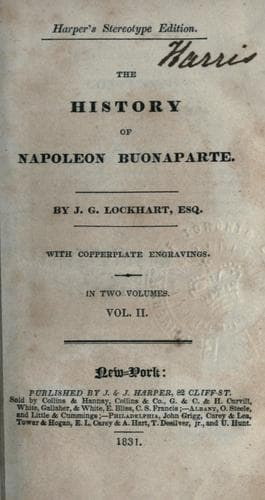
The History of Napoleon BuonaparteLockhart, J. G. (John Gibson)
History
The History of Napoleon Buonaparte
Lockhart, J. G. (John Gibson)
France -- Kings and rulers -- Biography; Napoleon I, Emperor of the French, 1769-1821
His favourite saying during the continuance of his power was, "I am the
State;" and in the exile of St. Helena he constantly talked of himself
as having been, from necessity, the Dictator of France. In effect no
despotism within many degrees so complete and rigid was every before
established in a civilised and Christian country. The whole territory
was divided into prefectures--each prefect being appointed by
Napoleon--carefully selected for a province with which he had no
domestic relations--largely paid--and entrusted with such a complete
delegation of power that, in Napoleon's own language, each was in his
department an _Empereur à petit pied_. Each of these officers had under
his entire control inferior local magistrates, holding power from him as
he did from the Emperor: each had his instructions direct from Paris;
each was bound by every motive of interest to serve, to the utmost of
his ability, the government from which all things were derived, to be
hoped for, and to be dreaded. Wherever the Emperor was, in the midst of
his hottest campaigns, he examined the details of administration at home
more closely than, perhaps, any other sovereign of half so great an
empire did during the profoundest peace. It was said of him that his
dearest amusement, when he had nothing else to do, was to solve problems
in algebra or geometry. He carried this passion into every department of
affairs; and having, with his own eye, detected some errors of
importance in the public accounts, shortly after his administration
began, there prevailed thenceforth in all the financial records of the
state such clearness and accuracy as are not often exemplified in those
of a large private fortune. Nothing was below his attention, and he
found time for everything. The humblest functionary discharged his duty
under a lively sense of the Emperor's personal superintendence; and the
omnipresence of his police came in lieu, wherever politics were not
touched upon, of the guarding powers of a free press, a free senate, and
public opinion. Except in political cases the trial by jury was the
right of every citizen. The _Code Napoleon_, that elaborate system of
jurisprudence, in the formation of which the Emperor laboured personally
along with the most eminent lawyers and enlightened men of the time, was
a boon of inestimable value to France. "I shall go down to posterity"
(said he, with just pride) "with the Code in my hand." It was the first
uniform system of laws which the French Monarchy had ever possessed: and
being drawn up with consummate skill and wisdom, it at this day forms
the code not only of France, but of a great portion of Europe besides.
Justice, as between man and man, was administered on sound and fixed
principles, and by unimpeached tribunals. The arbitrary Commission
Courts of Napoleon interfered with nothing but offences, real or
alleged, against his authority.
Public-domain text, read in full here on John Shaqi.
Reviews
Reviews
No reviews yet
Be the first to share your thoughts on this work.
Elsewhere in the archive
Join the Discussion
Join the discussion
Sign in to leave a comment or review.
Sign InorCreate an account