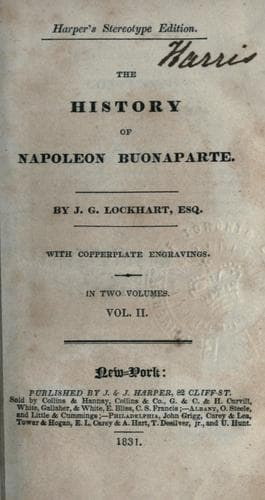
The History of Napoleon BuonaparteLockhart, J. G. (John Gibson)
History
The History of Napoleon Buonaparte
Lockhart, J. G. (John Gibson)
France -- Kings and rulers -- Biography; Napoleon I, Emperor of the French, 1769-1821
Napoleon received the intelligence with alarm; but he had already gone
too far to retract without disturbing the magical influence of his
reputation. He, moreover, was willing to flatter himself that the lower
population of Spain alone took an active part in these transactions;
that the nobility, whose degradation he could hardly over-estimate,
would abide by his voice; in a word, that with 80,000 troops in Spain,
besides Junot's army in Portugal, he possessed the means of suppressing
the tumult after the first effervescence should have escaped. He
proceeded, therefore, to act precisely as if no insurrection had
occurred. Tranquillity being re-established in Madrid, the Council of
Castile were convoked, and commanded to elect a new sovereign: their
choice had of course been settled beforehand: it fell on Joseph
Buonaparte, King of Naples; and ere it was announced, that personage was
already on his way to Bayonne. Ninety-five _Notables_ of Spain met him
in that town; and swore fealty to him and a new Constitution, the
manufacture of course of Napoleon. Joseph, on entering Spain, was met by
unequivocal symptoms of scorn and hatred:--nay, one great battle had
already been fought between the French and the patriots:--but, the main
road being strongly occupied throughout with his brother's troops, he
reached Madrid in safety.
Lucien Buonaparte, it is understood, received the first offer of this
crown; but he did not envy the condition of his brother's royal vassals,
and declined the dangerous honour. Murat had expected it, and much
resented his disappointment; but Napoleon did not consider him as
possessed of the requisite prudence, and he was forced to accept the
succession to the vacant throne of Naples.
Joseph had become not unpopular in Naples, and being a peaceful man,
would gladly have remained in that humbler kingdom; but Napoleon no more
consulted the private wishes of his subaltern princes on such occasions,
than he did those of his generals in the arrangements of a campaign.
On the 24th of July (says Colonel Napier), "Joseph was proclaimed King
of Spain and the Indies, with all the solemnities usual upon such
occasions; not hesitating to declare himself the enemy of eleven
millions of people, the object of a whole nation's hatred; calling, with
a strange accent, from the midst of foreign bands, upon that fierce and
haughty race to accept of a constitution which they did not understand,
and which few of them had even heard of; his only hope of success
resting on the strength of his brother's arms; his claims on the consent
of an imbecile monarch and the weakness of a few pusillanimous nobles,
in contempt of the rights of millions now arming to oppose him."
[Footnote 58: Colonel Napier, p. 25.]
CHAPTER XXIV
Public-domain text, read in full here on John Shaqi.
Reviews
Reviews
No reviews yet
Be the first to share your thoughts on this work.
Elsewhere in the archive
Join the Discussion
Join the discussion
Sign in to leave a comment or review.
Sign InorCreate an account