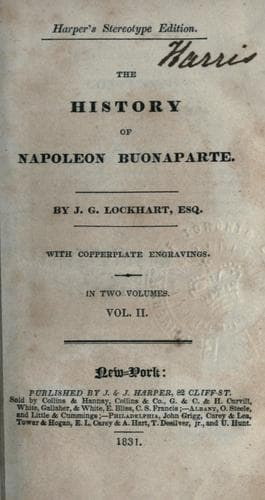
The History of Napoleon BuonaparteLockhart, J. G. (John Gibson)
History
The History of Napoleon Buonaparte
Lockhart, J. G. (John Gibson)
France -- Kings and rulers -- Biography; Napoleon I, Emperor of the French, 1769-1821
The apartments of Napoleon, and those of his wife, which were
immediately over them, at the Tuileries, had communication by means of a
private staircase; and it was the custom of the Emperor himself to
signify, by a tap on the door of Josephine's sitting-room, his desire to
converse with her in his cabinet below. In the days of their cordial
union the signal was often made, most commonly in the evening, and it
was not unusual for them to remain shut up together in conversation for
hours. Soon after his return from Schoenbrunn, the ladies in attendance
began to remark that the Emperor's knock was heard more frequently than
it had ever used to be, that their mistress seemed to listen for it at
certain hours with a new and painful anxiety, and that she did not obey
the signal with her accustomed alacrity. One evening Napoleon surprised
them by carrying Josephine into the midst of them, pale, apparently
lifeless. She was but awaking from a long swoon into which she had
fallen on hearing him at last pronounce the decree which terminated
their connection.
This was on the 5th of December. On the 15th the Emperor summoned his
council, and announced to them, that at the expense of all his personal
feelings, he, devoted wholly to the welfare of the state, had resolved
to separate himself from his most dear consort. Josephine then appeared
among them, and, not without tears, expressed her acquiescence in the
decree. The council, after haranguing the imperial spouses on the
nobleness of their mutual sacrifice, accepted and ratified the
dissolution of the marriage. The title of Empress was to continue with
Josephine for life, and a pension of two millions of francs (to which
Napoleon afterwards added a third million from his privy purse) was
allotted to her. She retired from the Tuileries, residing thenceforth
mostly at the villa of Malmaison; and in the course of a few weeks it
was signified that Napoleon had demanded the hand of the Archduchess
Maria Louisa, daughter to the Emperor Francis, the same youthful
princess who has been mentioned as remaining in Vienna, on account of
illness, during the second occupation of that capital.
Public-domain text, read in full here on John Shaqi.
Reviews
Reviews
No reviews yet
Be the first to share your thoughts on this work.
Elsewhere in the archive
Join the Discussion
Join the discussion
Sign in to leave a comment or review.
Sign InorCreate an account