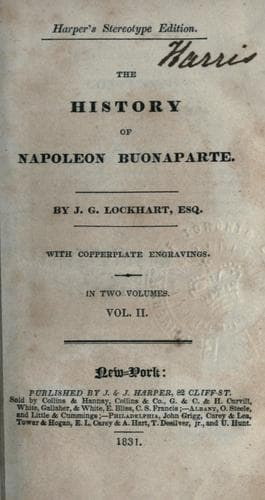
The History of Napoleon BuonaparteLockhart, J. G. (John Gibson)
History
The History of Napoleon Buonaparte
Lockhart, J. G. (John Gibson)
France -- Kings and rulers -- Biography; Napoleon I, Emperor of the French, 1769-1821
Napoleon, however, had never forgiven Bernadotte for his refusal to act
on his side on the 18th Brumaire. He thenceforth considered this great
soldier of the Republic as one who might serve the Emperor well, because
in doing so he served France, but who looked to himself with none of
those feelings of personal devotion which could alone entitle a subject
to his favour. Bernadotte had been distinguished in the army before
Napoleon himself appeared on the great theatre of events; he could never
be classed with those who had earned all their distinction and
pre-eminence under the banners of the Emperor; he had an existence
separate and his own; he had stood aloof at the great and decisive
crisis of Napoleon's fate; he might be entrusted and employed
afterwards--he could never be loved. The proposal of the Diet,
therefore, was the reverse of agreeable to him whose favour it was
expressly designed to conciliate. Bernadotte, however, was powerful in
the esteem of a great party in the French army, as well as among the old
republicans of the state: to have interfered against him would have been
to kindle high wrath and hatred among all those officers who belonged
to the ante-Buonapartean period; and, on the other hand, to oppose the
free-will of the Swedes would have appeared extraordinary conduct indeed
on the part of a sovereign who studiously represented himself as owing
everything to the free-will of the French. Sweden, finally, was still an
independent state; and the events of the Peninsula were likely to
impress the Emperor with a lively sense of the dangers of exciting a
spirit of national aversion at the other extremity of Europe. Napoleon
consented to the acceptance of the proffered dignity by Bernadotte. The
Marshal was called on to sign a declaration, before he left Paris, that
he would never bear arms against France. He rejected this condition as
incompatible with the connexion which Napoleon himself had just
sanctioned him in forming with another state, and said he was sure the
suggestion came not from the Emperor, who knew what were the duties of a
sovereign, but from some lawyer. Napoleon frowned darkly, and answered
with an air of embarrassment, "Go; our destinies are about to be
fulfilled." Bernadotte said he had not heard his words distinctly:
Napoleon repeated them; and they parted. Bernadotte was received with an
enthusiastic welcome in Stockholm; and, notwithstanding the unpleasant
circumstances under which Napoleon had dismissed him, the French
alliance continued to be maintained. The private history of the
transaction was not likely to be divulged at the time; and the natural
as well as universal notion was, that Sweden, governed in effect by
Marshal Bernadotte as crown prince, had become almost as mere a
dependence of France as Naples under King Joachim Murat, or Westphalia
under King Jerome Buonaparte.
Public-domain text, read in full here on John Shaqi.
Reviews
Reviews
No reviews yet
Be the first to share your thoughts on this work.
Elsewhere in the archive
Join the Discussion
Join the discussion
Sign in to leave a comment or review.
Sign InorCreate an account