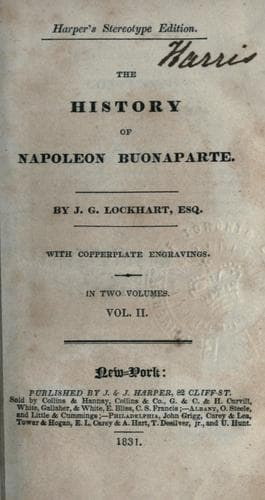
The History of Napoleon BuonaparteLockhart, J. G. (John Gibson)
History
The History of Napoleon Buonaparte
Lockhart, J. G. (John Gibson)
France -- Kings and rulers -- Biography; Napoleon I, Emperor of the French, 1769-1821
Lord Wellington had thus ventured to place himself in the heart of
Spain, with, at most, 60,000 men, well-knowing that the French armies in
the Peninsula still mustered at the least 150,000 in the expectation
that so spirited a movement, coming after the glorious successes of
Ciudad Rodrigo, Badajos, and Salamanca, would effectually stimulate the
Spanish generals. Ballasteros in particular, he doubted not, would at
least take care to occupy all the attention of Soult, and prevent that
able leader from advancing out of the south. But the Spaniard's
egregious pride took fire at the notion of being directed by an
Englishman, and he suffered Soult to break up the siege of Cadiz, and
retire with all his army undisturbed towards the Sierra Morena. Lord
Wellington, incensed at this folly, was constrained to divide his army.
Leaving half at Madrid under Sir R. Hill, to check Soult, he himself
marched with the other for Burgos, by taking which great city he judged
he should have it in his power to overawe effectually the remains of the
army of Marmont. He invested Burgos accordingly on the 19th of
September, and continued the siege during five weeks, until Soult, with
a superior force, began to threaten Hill, and (Marmont's successor)
Clausel, having also received great reinforcements, appeared ready to
resume the offensive. Lord Wellington then abandoned the siege of Burgos
and commenced his retreat. He was joined in the course of it by Hill,
and Soult and Clausel then effected their junction also, in his
rear--their troops being nearly double his numbers. He retired leisurely
and deliberately as far as Ciudad Rodrigo--and thus closed the
Peninsular campaign of 1812. But in sketching its progress we have lost
sight for a moment of the still mightier movements in which Napoleon was
personally engaged upon another scene of action.
It has already been mentioned, that before the year 1811 reached its
close, the approach of a rupture with Russia was sufficiently indicated
in an edict of the Emperor of Austria, granting a free passage through
his territories to the armies of his son-in-law. However, during several
months following, the negotiations between the Czar and Napoleon
continued; and more than once there appeared considerable likelihood of
their finding an amicable termination. The tidings of Lord Wellington's
successes at Ciudad Rodrigo and Badajos were calculated to temper the
ardour of Buonaparte's presumption; and for a moment he seems to have
felt the necessity of bringing the affairs of the Peninsula to a point,
ere he should venture to involve himself in another warfare. He, in
effect, opened a communication with the English government, when the
fall of Badajos was announced to him; but before the negotiation had
proceeded many steps, his pride returned on him in its original
obstinacy, and the renewed demand, that Joseph should be recognised as
King of Spain, abruptly closed the intercourse of the diplomatists.
Public-domain text, read in full here on John Shaqi.
Reviews
Reviews
No reviews yet
Be the first to share your thoughts on this work.
Elsewhere in the archive
Join the Discussion
Join the discussion
Sign in to leave a comment or review.
Sign InorCreate an account