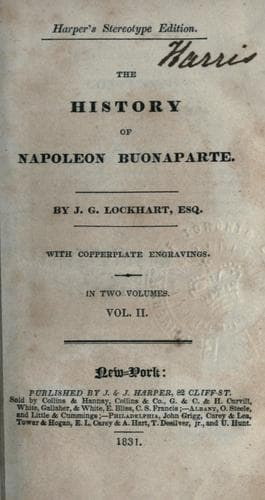
The History of Napoleon BuonaparteLockhart, J. G. (John Gibson)
History
The History of Napoleon Buonaparte
Lockhart, J. G. (John Gibson)
France -- Kings and rulers -- Biography; Napoleon I, Emperor of the French, 1769-1821
On the other flank of the Czar's dominion--his hereditary enemy, the
Grand Seignior, was at this time actually at war with him. Napoleon had
neglected his relations with Constantinople for some years past; but he
now perceived the importance of keeping this quarrel alive, and
employed his agents to stimulate the Grand Seignior to take the field
in person at the head of 100,000 men, for the purpose of co-operating
with himself in a general invasion of the Russian empire. But here he
encountered a new and an unforeseen difficulty. Lord Castlereagh, the
English minister for foreign affairs, succeeded in convincing the Porte,
that, if Russia were once subdued, there would remain no power in Europe
capable of shielding her against the universal ambition of Napoleon. And
wisely considering this prospective danger as immeasurably more
important than any immediate advantage which she could possibly reap
from the humiliation of her old rival, the Porte commenced a
negotiation, which, exactly at the most critical moment (as we shall see
hereafter) ended in a peace with Russia.
The whole forces of Italy--Switzerland, Bavaria, and the princes of the
Rhenish League,--including the Elector of Saxony,--were at Napoleon's
disposal. Denmark hated England too much to have leisure for fear of
him. Prussia, surrounded and studded with French garrisons, was more
than ever hostile to France; and the king was willing, in spite of all
that he had suffered, to throw himself at once into the arms of Russia.
But this must have inferred his immediate and total ruin, unless the
Czar chose to march at once into Germany. Such a movement was wholly
inconsistent with the plan of operations contemplated, in case of a war
with Buonaparte, by the military advisers of Alexander; and Frederick
William saw himself compelled to place 20,000 troops, the poor relics of
his army, at the disposal of the common oppressor.
Public-domain text, read in full here on John Shaqi.
Reviews
Reviews
No reviews yet
Be the first to share your thoughts on this work.
Elsewhere in the archive
Join the Discussion
Join the discussion
Sign in to leave a comment or review.
Sign InorCreate an account