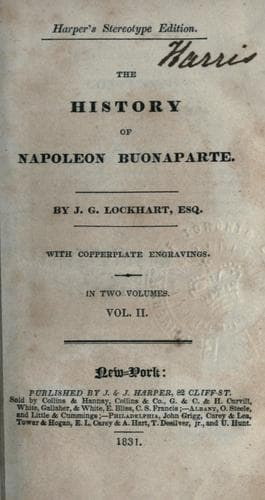
The History of Napoleon BuonaparteLockhart, J. G. (John Gibson)
History
The History of Napoleon Buonaparte
Lockhart, J. G. (John Gibson)
France -- Kings and rulers -- Biography; Napoleon I, Emperor of the French, 1769-1821
Provera now found himself entirely cut off from Alvinzi, and surrounded
with the French. He and 5000 men laid down their arms on the 16th of
January. Various bodies of the Austrian force, scattered over the
country between the Adige and the Brenta, followed the example;[14] and
the brave Wurmser, whose provisions were by this time exhausted, found
himself at length under the necessity of sending an offer of
capitulation.
General Serrurier, as commander of the blockade, received Klenau, the
bearer of Wurmser's message, and heard him state, with the pardonable
artifice usual on such occasions, that his master was still in a
condition to hold out considerably longer, unless honourable terms were
granted. Napoleon had hitherto been seated in a corner of the tent
wrapped in his cloak; he now advanced to the Austrian, who had no
suspicion in whose presence he had been speaking, and taking his pen,
wrote down the conditions which he was willing to grant. "These," said
he, "are the terms to which your general's bravery entitles him. He may
have them to-day; a week, a month hence, he shall have no worse.
Meantime, tell him that General Buonaparte is about to set out for
Rome." The envoy now recognised Napoleon; and on reading the paper
perceived that the proposed terms were more liberal than he had dared to
hope for. The capitulation was forthwith signed.
On the 2nd of February, Wurmser and his garrison marched out of Mantua;
but when the aged chief was to surrender his sword, he found only
Serrurier ready to receive it. Napoleon's generosity, in avoiding being
present personally to witness the humiliation of this distinguished
veteran, forms one of the most pleasing traits in his story. The
Directory had urged him to far different conduct. He treated their
suggestions with scorn: "I have granted the Austrian," he wrote to them,
"such terms as were, in my judgment, due to a brave and honourable
enemy, and to the dignity of the French Republic."
The loss of the Austrians at Mantua amounted, first and last, to not
less than 27,000 men. Besides innumerable military stores, upwards of
500 brass cannon fell into the hands of the conqueror; and Augereau was
sent to Paris, to present the Directory with _sixty_ stands of colours.
He was received with tumults of exultation, such as might have been
expected, on an occasion so glorious, from a people less vivacious than
the French.
Public-domain text, read in full here on John Shaqi.
Reviews
Reviews
No reviews yet
Be the first to share your thoughts on this work.
Join the Discussion
Join the discussion
Sign in to leave a comment or review.
Sign InorCreate an account