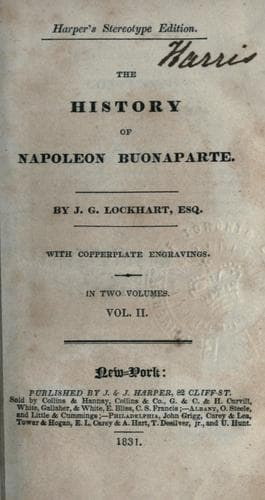
The History of Napoleon BuonaparteLockhart, J. G. (John Gibson)
History
The History of Napoleon Buonaparte
Lockhart, J. G. (John Gibson)
France -- Kings and rulers -- Biography; Napoleon I, Emperor of the French, 1769-1821
Buonaparte found the Archduke posted behind the river Tagliamento, in
front of the rugged Carinthian mountains, which guard the passage in
that quarter from Italy to Germany. Detaching Massena to the Piave,
where the Austrian division of Lusignan were in observation, he himself
determined to charge the Archduke in front. Massena was successful in
driving Lusignan before him as far as Belluno, (where a rear guard of
500 surrendered,) and thus turned the Austrian flank. Buonaparte then
attempted and effected the passage of the Tagliamento. After a great and
formal display of his forces, which was met by similar demonstrations
on the Austrian side of the river, he suddenly broke up his line and
retreated. The Archduke, knowing that the French had been marching all
the night before, concluded that the general wished to defer the battle
till another day; and in like manner withdrew to his camp. About two
hours after Napoleon rushed with his whole army, who had merely lain
down in ranks, upon the margin of the Tagliamento, no longer adequately
guarded--and had forded the stream ere the Austrian line of battle could
be formed. In the action which followed (March 12) the troops of the
Archduke displayed much gallantry, but every effort to dislodge Napoleon
failed; at length retreat was judged necessary. The French followed hard
behind. They stormed Gradisca, where they made 5000 prisoners; and--the
Archduke pursuing his retreat--occupied in the course of a few days
Trieste, Fiume, and every stronghold in Carinthia. In the course of a
campaign of twenty days, the Austrians fought Buonaparte ten times, but
the overthrow on the Tagliamento was never recovered; and the Archduke,
after defending Styria inch by inch as he had Carinthia, at length
adopted the resolution of reaching Vienna by forced marches, there to
gather round him whatever force the loyalty of his nation could muster,
and make a last stand beneath the walls of the capital.
Public-domain text, read in full here on John Shaqi.
Reviews
Reviews
No reviews yet
Be the first to share your thoughts on this work.
Elsewhere in the archive
Join the Discussion
Join the discussion
Sign in to leave a comment or review.
Sign InorCreate an account