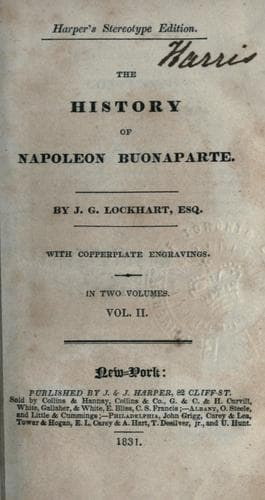
The History of Napoleon BuonaparteLockhart, J. G. (John Gibson)
History
The History of Napoleon Buonaparte
Lockhart, J. G. (John Gibson)
France -- Kings and rulers -- Biography; Napoleon I, Emperor of the French, 1769-1821
This plan, at first sight the mere dictate of despair, was in truth that
of a wise and prudent general. The Archduke had received intelligence
from two quarters of events highly unfavourable to the French. General
Laudon, the Austrian commander on the Tyrol frontier, had descended
thence with forces sufficient to overwhelm Buonaparte's lieutenants on
the upper Adige, and was already in possession of the whole Tyrol, and
of several of the Lombard towns. Meanwhile the Venetian Senate, on
hearing of these Austrian successes, had plucked up courage to throw
aside their flimsy neutrality, and not only declared war against France,
but encouraged their partizans in Verona to open the contest with an
inhuman massacre of the French wounded in the hospitals of that city.
The vindictive Italians, wherever the French party was inferior in
numbers, resorted to similar atrocities. The few troops left in Lombardy
by Napoleon were obliged to shut themselves up in garrisons, which the
insurgent inhabitants of the neighbouring districts invested. The
Venetian army passed the frontier; and, in effect, Buonaparte's means
of deriving supplies of any kind from his rear were for the time wholly
cut off. It was not wonderful that the Archduke should, under such
circumstances, anticipate great advantage from enticing the French army
into the heart of Austria; where, divided by many wide provinces and
mighty mountains and rivers from France, and with Italy once more in
arms behind them, they should have to abide the encounter of an imperial
army, animated by all the best motives that can lend vigour to the arm
of man; fighting for their own hearths under the eyes of their own
sovereign; seconded everywhere by the loyalty of the peasants; and well
convinced that, if they could compel their enemy to a retreat, his total
ruin must be the consequence.
The terror of the Aulic Council stepped in to prevent the Archduke from
reaping either the credit or the disgrace of this movement. Vienna was
panic-struck on hearing that Buonaparte had stormed the passes of the
Julian Alps; the imperial family sent their treasure into Hungary; the
middle ranks, whose interest is always peace, became clamorous for some
termination to a war, which during six years had been so unfortunate;
and the Archduke was ordered to avail himself of the first pretence
which circumstances might afford for the opening of a negotiation.
Public-domain text, read in full here on John Shaqi.
Reviews
Reviews
No reviews yet
Be the first to share your thoughts on this work.
Elsewhere in the archive
Join the Discussion
Join the discussion
Sign in to leave a comment or review.
Sign InorCreate an account