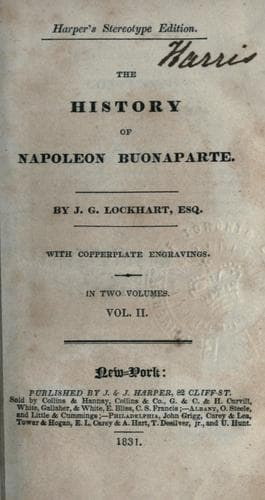
The History of Napoleon BuonaparteLockhart, J. G. (John Gibson)
History
The History of Napoleon Buonaparte
Lockhart, J. G. (John Gibson)
France -- Kings and rulers -- Biography; Napoleon I, Emperor of the French, 1769-1821
Popular tumults filled the streets and canals; universal confusion
prevailed. The commanders of their troops and fleets received
contradictory orders, and the city which
"--had held the gorgeous East in fee,"
seemed ready to yield everything to a ruthless and implacable enemy,
without even striking a blow in defence.
Buonaparte appeared, while the confusion was at its height, on the
opposite coast of the Lagoon. Some of his troops were already in the
heart of the city, when (31st May) a hasty message reached him,
announcing that the Senate submitted wholly. He exacted severe revenge.
The leaders who had aided the Lombard insurgents were delivered to him.
The oligarchy ceased to rule, and a democratical government was formed,
provisionally, on the model of France. Venice consented to surrender to
the victor large territories on the mainland of Italy; five ships of
war; 3,000,000 francs in gold, and as many more in naval stores; twenty
of the best pictures, and 500 manuscripts. Lastly, the troops of the
conqueror were to occupy the capital until tranquillity was established.
It will be seen in what that tranquillity was destined to consist.
Such was the humiliation of this once proud and energetic, but now
worn-out and enfeebled, oligarchy: so incapable was that hoary polity of
contending with the youthful vigour of Napoleon.
[Footnote 17: The armorial bearing of Venice.]
CHAPTER IX
Pichegru--The Directory appeal to Buonaparte--The 18th
Fructidor--The Court of Montebello--Josephine--The Treaty of
Campo-Formio--Buonaparte leaves Italy.
In their last agony the Venetian Senate made a vain effort to secure the
personal protection of the general, by offering him a purse of seven
millions of francs. He rejected this with scorn. He had already treated
in the same style a bribe of four millions, tendered on the part of the
Duke of Modena. The friend employed to conduct the business reminded him
of the proverbial ingratitude of all popular governments, and of the
little attention which the Directory had hitherto paid to his personal
interests. "That is all true enough," said Napoleon, "but for four
millions I will not place myself in the power of this duke." Austria
herself, it is said, did not hesitate to tamper in the same manner,
though far more magnificently, as became her resources, with his
republican virtue. He was offered, if the story be true, an independent
German principality for himself and his heirs. "I thank the emperor," he
answered, "but if greatness is to be mine, it shall come from France."
Public-domain text, read in full here on John Shaqi.
Reviews
Reviews
No reviews yet
Be the first to share your thoughts on this work.
Elsewhere in the archive
Join the Discussion
Join the discussion
Sign in to leave a comment or review.
Sign InorCreate an account