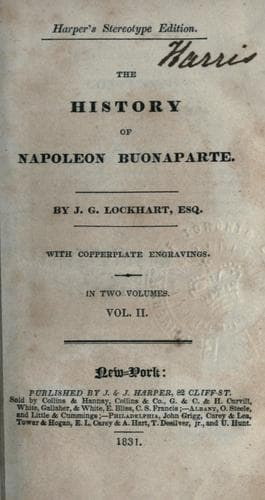
The History of Napoleon BuonaparteLockhart, J. G. (John Gibson)
History
The History of Napoleon Buonaparte
Lockhart, J. G. (John Gibson)
France -- Kings and rulers -- Biography; Napoleon I, Emperor of the French, 1769-1821
That prince had already, acting on his own judgment and feelings,
dismissed such an occasion with civility and with coldness. Napoleon had
addressed a letter to his Imperial Highness from Clagenfurt, in which he
called on him, as a brother soldier, to consider the certain miseries
and the doubtful successes of war, and put an end to the campaign by a
fair and equitable treaty. The Archduke replied, that he regarded with
the highest esteem the personal character of his correspondent, but that
the Austrian government had committed to his trust the guidance of a
particular army, not the diplomatic business of the empire. The prince,
on receiving these new instructions from Vienna, perceived, however
reluctantly, that the line of his duty was altered; and the result was a
series of negotiations--which ended in the provisional treaty of Leoben,
signed April 18, 1797.
It was here, at Leoben, that Buonaparte's schoolfellow, De Bourienne,
who had been summoned to act as secretary to the general, reached
headquarters. He found his old comrade (whom he had not met with since
the days of his envying small houses and cabriolets in Paris) in the
midst of a splendid staff. "So thou art come at last," cried Napoleon,
in the ancient tone of familiarity; but De Bourienne knew the world, and
greeted the general of the army of Italy with profound and distant
respect. When the company were gone, Buonaparte signified that he
understood and approved this change of demeanour.
But to resume--no sooner was the negotiation in a fair train, than
Napoleon, abandoning for the moment the details of its management to
inferior diplomatists, hastened to retrace his steps, and pour the full
storm of his wrath on the Venetians. The Doge and the Senate, whose only
hopes had rested on the successes of Austria on the Adige, heard with
utter despair that the Archduke had shared the fate of Beaulieu, of
Wurmser, and of Alvinzi, and that the preliminaries of peace were
actually signed. The rapidity of Buonaparte's return gave them no
breathing-time. They hastened to send offers of submission, and their
messengers were received with anger and contempt. "French blood has been
treacherously shed," said Napoleon; "if you could offer me the treasures
of Peru, if you could cover your whole dominion with gold--the atonement
would be insufficient--the lion of St. Mark[17] must lick the dust."
These tidings came like a sentence of death upon the devoted Senate.
Their deliberations were unceasing; their schemes innumerable; their
hearts divided and unnerved. Those secret chambers, from which that
haughty oligarchy had for so many ages excluded every eye and every
voice but their own, were invaded with impunity by strange-faced men,
who boldly criticised their measures, and heaped new terrors on their
heads, by announcing that the mass of the people had ceased to consider
the endurance of their sway as synonymous with the prosperity of Venice.
Public-domain text, read in full here on John Shaqi.
Reviews
Reviews
No reviews yet
Be the first to share your thoughts on this work.
Elsewhere in the archive
Join the Discussion
Join the discussion
Sign in to leave a comment or review.
Sign InorCreate an account