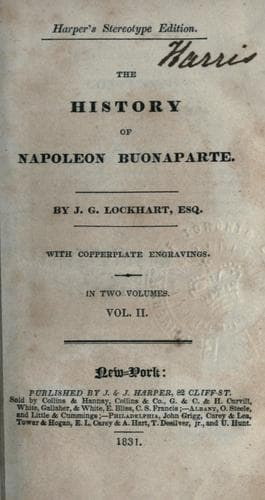
The History of Napoleon BuonaparteLockhart, J. G. (John Gibson)
History
The History of Napoleon Buonaparte
Lockhart, J. G. (John Gibson)
France -- Kings and rulers -- Biography; Napoleon I, Emperor of the French, 1769-1821
While Napoleon was thus pursuing his career of victory in the interior,
Nelson, having scoured the Mediterranean in quest of him, once more
returned to the coast of Egypt. He arrived within sight of the towers of
Alexandria on the 1st of August--ten days after the battle of the
Pyramids had been fought and won--and found Brueyes still at his
moorings in the bay of Aboukir. Nothing seems to be more clear than that
the French admiral ought to have made the best of his way to France, or
at least to Malta, the moment the army had taken possession of
Alexandria. Napoleon constantly asserted that he had urged Brueyes to do
so. Brueyes himself lived not to give his testimony; but Gantheaume, the
vice-admiral, always persisted in stating, in direct contradiction to
Buonaparte, that the fleet remained by the General's express desire. The
testimonies being thus balanced, it is necessary to consult other
materials of judgment; and it appears extremely difficult to doubt that
the French admiral,--who, it is acknowledged on all hands, dreaded the
encounter of Nelson--remained off Alexandria for the sole purpose of
aiding the motions of the army, and in consequence of what he at least
conceived to be the wish of its general. However this might have been,
the results of his delay were terrible.
The French fleet were moored in a semicircle in the bay of Aboukir, so
near the shore, that, as their admiral believed, it was impossible for
the enemy to come between him and the land. He expected, therefore, to
be attacked on one side only, and thought himself sure that the English
could not renew their favourite manœuvre of breaking the line,[25] and
so at once dividing the opposed fleet, and placing the ships
individually between two fires. But Nelson daringly judged that his
ships might force a passage between the French and the land, and
succeeding in this attempt, instantly brought on the conflict, in the
same dreaded form which Brueyes had believed impossible. The details of
this great sea fight belong to the history of the English hero.[26] The
battle was obstinate--it lasted more than twenty hours, including the
whole night. A solitary pause occurred at midnight, when the French
admiral's ship _L'Orient_, a superb vessel of 120 guns, took fire, and
blew up in the heart of the conflicting squadrons, with an explosion
that for a moment silenced rage in awe. The admiral himself perished.
Next morning two shattered ships, out of all the French fleet, with
difficulty made their escape to the open sea. The rest of all that
magnificent array had been utterly destroyed, or remained in the hands
of the English.
Public-domain text, read in full here on John Shaqi.
Reviews
Reviews
No reviews yet
Be the first to share your thoughts on this work.
Elsewhere in the archive
Join the Discussion
Join the discussion
Sign in to leave a comment or review.
Sign InorCreate an account