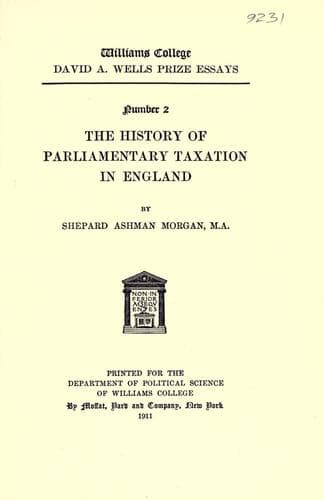
The History of Parliamentary Taxation in EnglandMorgan, Shepard Ashman
History
The History of Parliamentary Taxation in England
Morgan, Shepard Ashman
Taxation -- Great Britain; Taxation -- Great Britain -- History
[77] Chapter 12. No scutage or aid shall be imposed in our kingdom,
except by the common council of our kingdom, except for the ransoming
of our body, for the making of our oldest son a knight, and for once
marrying our oldest daughter, and for these purposes it shall be only
a reasonable aid; in the same way it shall be done concerning the aids
of the city of London. Adams and Stephens, _Select Documents of Eng.
Const. Hist._ 44. Latin text, Stubbs, _Select Charters_, 298.
[78] Below, 66.
[79] 1 Stubbs, _Const. Hist. Eng._ 573.
[80] Taswell-Langmead, _Eng. Const. Hist._ 101.
[81] See McKechnie, _Magna Carta_, 274, 284, 291-301.
[82] “Tallage was a tax levied at a feudal lord’s arbitrary will upon
more or less servile dependants, who had neither power nor right to
refuse.” McKechnie, _Magna Carta_, 228.
[83] Chapter 14, “And for holding a common council of the kingdom
concerning the assessment of an aid otherwise than in the three cases
mentioned above, or concerning the assessment of a scutage, we shall
cause to be summoned the archbishops, bishops, abbots, earls, and
greater barons by our letters individually; and besides we shall cause
to be summoned generally, by our sheriffs and bailiffs all those who
hold from us in chief, for a certain day, that is at the end of forty
days at least, and for a certain place; and in all the letters of that
summons, we will express the cause of the summons, and when the summons
has thus been given the business shall proceed on the appointed day, on
the advice of those who shall be present, even if not all of those who
were summoned have come.” Adams and Stephens, _Select Documents_, 44.
The Latin text is in Stubbs, _Select Charters_, 299.
[84] Cap. 42 of this reissue of the Charter states the promise of the
king to return to the matter of the levying of scutages and aids, when
the occasion should be more propitious. McKechnie, _Magna Carta_,
168-169.
[85] Cap. 44. Scutagium decetero capiatur sicut capi consuevit tempore,
regis Henrici avi nostri. McKechnie, _Magna Carta_, 585, where also is
the text of the entire reissue.
[86] McKechnie, _Magna Carta_, 173-174.
[87] 1 _Rotuli Litterarum Clausarum_, 349.
[88] 2 Stubbs, _Const. Hist. Eng._ 30, note 1. He bases his belief on
the fact that “the orders for the collecting this scutage were issued
Feb. 22, the same day on which the writs for proclaiming the charters
are dated,” and cites 1 _Rot. Claus._ 377. In the same note he records
the following instances of taxation:
“June 7, 1217, the king mentions a carucage, hidage and aid, ‘quod de
præcepto nostro assisum est.’ 1 _Rot. Claus._ 310.”
“Jan. 9, 1218, Henry mentions a carucage and hidage, ‘quod assisum fuit
per consilium regni nostri.’ 1 _Rot. Claus._ 348.
“Jan. 17, Henry mentions a scutage of two marks on the fee, ‘quod
exegimus,’ and
Public-domain text, read in full here on John Shaqi.
Reviews
Reviews
No reviews yet
Be the first to share your thoughts on this work.
Elsewhere in the archive
Join the Discussion
Join the discussion
Sign in to leave a comment or review.
Sign InorCreate an account