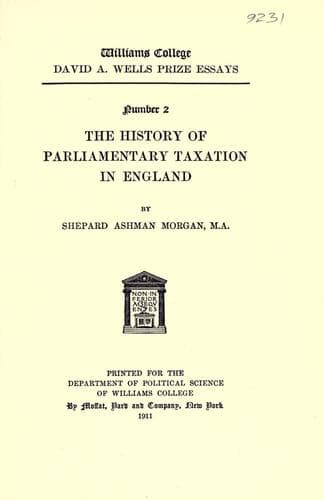
The History of Parliamentary Taxation in EnglandMorgan, Shepard Ashman
History
The History of Parliamentary Taxation in England
Morgan, Shepard Ashman
Taxation -- Great Britain; Taxation -- Great Britain -- History
1252. The Pope held Henry to his promise of a Crusade made in 1250, and
authorized him to exact a tenth of the revenues of the clergy for three
years. The clergy delayed. Henry turned to the barons and asked for a
scutage; the barons answered that their reply would depend upon the
prelates. 2 Matt. Par. _Chron. Maj._ trans. Giles, 518-527.
1253. Debate on the above. At last Henry obtained his tenth from
the clergy and an aid of 3 marks from the tenants-in-chief for the
knighting of his son. The condition was the confirmation of the
Charters, and a great oath for his faithful observance of them. 3 Matt.
Par. _Chron. Maj._ trans. Giles, 22-24.
[103] 2 Matt. Par. _Chron. Maj._ trans. Giles, 254-257, 266-267.
[104] 2 Matt. Par. _Chron. Maj._ trans. Giles, 287.
[105] One of the royal writs ran thus:
“Rex Vicecomiti Bedeford, et Bukingeham., salutem.... Tibi districte
præcipimus, quod præter omnes prædictos venire facias coram consilio
nostro apud Westmonasterium in quindena Paschæ proximo futuri,
quatuor legales et discretos milites de comitatibus prædictis quos
iidem comitatus ad hoc elgerint, vice omnium et singulorum eorundem
comitatuum, videlicet duos de uno comitatu et duos de alio, ad
providendum, una cum militibus aliorum comitatuum quos ad eundem diem
vocari fecimus, quale auxilium nobis in tanta necessitate impendere
voluerint. Et tu ipse militibus et aliis de comitatibus prædictis
necessitatem nostram et tam urgens negotium nostrum diligenter exponas,
et eos ad competens auxilium nobis ad præsens impendendum efficaciter
inducas; ita quod prædicti quatuor milites præfato consilio nostro ad
prædictum terminum præcise respondere possint super prædicto auxilio
pro singulis comitatuum prædictorum.” Stubbs, _Select Charters_, 376.
Translation in Adams and Stephens, _Select Documents_, 55.
[106] 3 Matt. Par. _Chron. Maj._ trans. Giles, 75.
[107] “To a general assembly of the barons at London in 1246, the name
of Parliament, which had previously been indiscriminately ascribed
to assemblies of various kinds, is for the first time given by a
contemporary chronicler, Matthew Paris. Henceforth it became specially
though not exclusively, the appellation of the National Council.”
Taswell-Langmead, _Eng. Const. Hist._ 187.
[108] 3 Matt. Par. _Chron. Maj._ trans. Giles, 119.
[109] 3 Matt. Par. _Chron. Maj._ trans. Giles, 141-142.
[110] Cf. 2 Stubbs, _Const. Hist. Eng._ 70-73, and references there
cited.
[111] 3 Matt. Par. _Chron. Maj._ trans. Giles, 267-268, 271-272.
[112] 2 Stubbs, _Const. Hist. Eng._ 76-80; Stubbs, _Sel. Chart._ 378
ff.; Taswell-Langmead, _Eng. Const. Hist._ 188-189; 3 Matt. Par.
_Chron. Maj._ trans. Giles, 285-288.
[113] Stubbs, _Select Charters_, 382-387, especially caps. 22, 23.
[114] 1 Rymer, _Foedera_, part 2, 62.
[115] Stubbs, _Sel. Chart._ 405.
[116] Louis’s award was the so-called “Mise of Amiens.” Given in
Stubbs, _Sel. Chart._ 406. 1 Rymer, _Foedera_, part 2 83.
Public-domain text, read in full here on John Shaqi.
Reviews
Reviews
No reviews yet
Be the first to share your thoughts on this work.
Elsewhere in the archive
Join the Discussion
Join the discussion
Sign in to leave a comment or review.
Sign InorCreate an account