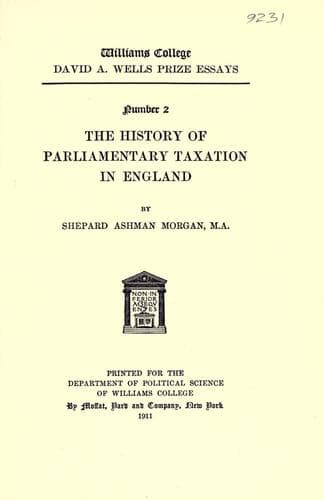
The History of Parliamentary Taxation in EnglandMorgan, Shepard Ashman
History
The History of Parliamentary Taxation in England
Morgan, Shepard Ashman
Taxation -- Great Britain; Taxation -- Great Britain -- History
[128] Wool, hides and leather formed the bulk of the early exports
from England. Wine was the principal import. It was on these articles
of merchandise, and such others as the merchants brought in and took
out, that duties had been charged since early times. The taxes had
become customary and were spoken of as “consuetudines,” or customs. The
basis for the exaction was the understanding that the merchants, most
of them foreigners, should be given protection by the king. The early
prisage on wine amounted to one cask from every cargo of from ten to
twenty casks, arriving at a port of England. From ships carrying more
than twenty casks, two casks were exacted. Sometimes the duty instead
of being made in wine was compounded for in money. The amount of the
export tax on wool in the beginning is not known. In merchandise of
other sorts, the payment amounted to a tenth or a fifteenth of the
value of the goods.
Magna Carta abolished illegal exactions on goods retaining only the
“ancient and lawful customs” above mentioned. Taxable commodities were
wine, wool, and general merchandise. In many instances, in spite of
the prohibitions in the Charter, the customs amounted to confiscation.
Until the time of Edward I there was unending irregularity in the
management of the customs. Merchant strangers, by Cap. 41 of the Great
Charter were to have “safe and secure exit from England, and entry to
England ... buying and selling by the ancient and right customs, quit
from all evil Tolls.”
[129] “Edwardus Dei Gratia Rex Angliæ dominus Hiberniæ et dux
Aquitanniæ vicecomiti Kanciæ salutem. Cum prælatis et magnatibus
regni nostri mandaverimus ut ipsi parliamento nostro, quod apud
Westmonasterium in quindena Sancti Michælis proxime futura tenebimus.
Domino concedenti intersint ad tractandum nobiscum tam super statum
regni nostri quam super quibusdam negotiis nostris quæ eis exponemus
ibidem, et expediens sit quod duo milites de comitatu prædicto de
discretioribus et legalioribus militibus ejusdem comitatus intersint
eidem parliamento, ex causis prædictis tibi præcipimus quod in pleno
comitatu tuo de assensu ejusdem comitatus eligi facias dictos duos
militis et eos ad nos usque Westmonasterium pro communitate dicti
comitatus venire facias ad dictum diem ad tractandum nobiscum et cum
prædictis prælatis et magnatibus super negotiis prædictis. Et hoc non
omittas....” 2 Stubbs, _Const. Hist. Eng._ 234, note 5.
[130] 1 _Rotuli Parliamentorum_, 224.
[131] _Ann._ T. Wykes, 274; Stubbs, _Sel. Chart._ 431.
[132] The statute of Gloucester, passed in 1278, provided for the
regulation of territorial franchises. In accordance with it, the
itinerant justices were to inquire by what warrant certain franchises
were held, and the writ “quo warranto” was issued in each case. Stubbs,
2 _Const. Hist. Eng._ 114-115.
[133] Writ for distraint of knighthood. 1 Stubbs, _Sel. Chart._ 457.
[134] Letter of credence for a royal commissioner to raise an aid.
Stubbs, _Sel. Chart._ 464.
Public-domain text, read in full here on John Shaqi.
Reviews
Reviews
No reviews yet
Be the first to share your thoughts on this work.
Elsewhere in the archive
Join the Discussion
Join the discussion
Sign in to leave a comment or review.
Sign InorCreate an account