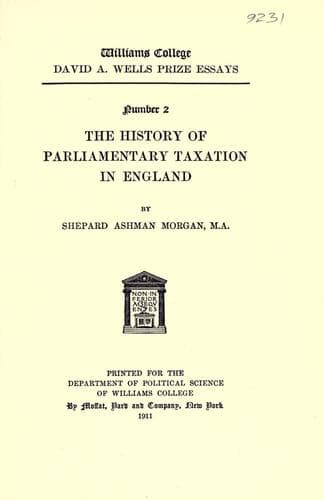
The History of Parliamentary Taxation in EnglandMorgan, Shepard Ashman
History
The History of Parliamentary Taxation in England
Morgan, Shepard Ashman
Taxation -- Great Britain; Taxation -- Great Britain -- History
What was left of the reign of Henry III, already stretched beyond its
time, is all but negligible. The position of Simon de Montfort was too
favorable to keep him clear of jealous rivals. War speedily started
up again and in an early battle, that of Evesham, the great earl was
slain. Two years thereafter, the royalist party managed to get the
upper hand and the war came to an end. Henry was wise enough, or old
enough, not to tempt Providence; he continued his reign according to
the dictates of law and of good policy. By the statute of Marlborough
in 1267 were granted most of the measures of reform which had been
demanded nine years previously in the Mad Parliament of Oxford. With
the affairs of state running thus smoothly, Henry moved tranquilly down
the long slope of his last years.
In October, 1269, there occurred an incident which, if indeed the
report be well founded, sums up the attainments of his reign. Henry
brought together a great assembly in honor of Saint Edward, an
assembly of magnates lay and clerical, and likewise numbering certain
representatives of the cities and boroughs.[122] After the conclusion
of the ceremony, Henry convened the barons as a Parliament, and
received from it a grant of a twentieth of lay movables. Whether or not
the burgesses and citizens participated in the offering to the king is
unknown. But if that be the truth, enveloped as it is in the mist,
then we can see the newly-made legislators actually participating in
the most important of legislative functions, and we are assured that
the work of Simon de Montfort had indeed borne early fruit.
IV
LAW OF PARLIAMENTARY TAXATION
1272-1297
[Edward I, 1272-1307]
HENRY died the 16th November, 1272, with his son, the great Edward,
away on the crusade. But there was no question as to the succession;
the most powerful of the barons swore fealty to Edward four days after
his father’s death, and when he returned to England in the middle of
1274, he was crowned King of England. In the interim, the government
was in the hands of the Archbishop of York; the barons still resting
after their struggle with Henry III engaged in no warfare other than
their usual petty tumults. The regular income of the crown sufficed for
the expenses of government.
Public-domain text, read in full here on John Shaqi.
Reviews
Reviews
No reviews yet
Be the first to share your thoughts on this work.
Join the Discussion
Join the discussion
Sign in to leave a comment or review.
Sign InorCreate an account