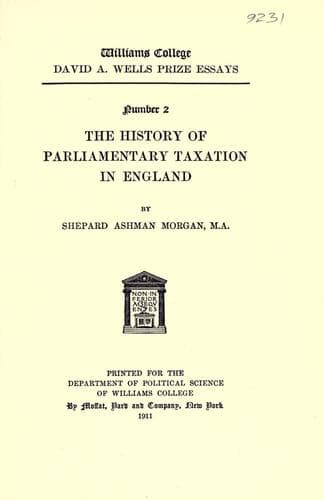
The History of Parliamentary Taxation in EnglandMorgan, Shepard Ashman
History
The History of Parliamentary Taxation in England
Morgan, Shepard Ashman
Taxation -- Great Britain; Taxation -- Great Britain -- History
Simon de Montfort on the 24th December following issued writs in the
king’s name bidding the sheriffs to send up two knights from the
shires, and each of some twenty-one especially designated cities and
boroughs to send up two citizens and burgesses to London.[120] The
Parliament was called for the 20th January, 1265. Beside the
representatives of the cities and boroughs, there was a very full
gathering of the clergy. The baronage, who as a body looked upon Earl
Simon’s cause with small favor, were called upon to send only
twenty-three of their number, five earls and eighteen barons.
[The first instance of burgher representation in Parliament]
[The House of Commons is foreshadowed]
It is upon this Parliament that the fame of Simon de Montfort as the
Creator of the House of Commons is established. Unless we admit as
an instance of borough representation the summons of the reeve and
four men from the demesne townships to the St. Albans Council in
1213, we have here the first participation of the burgher class, the
Third Estate of the Realm, in the Parliament of the nation. It was
to compose, along with the recently admitted representatives of the
shires, the House of Commons, and in its hands the destiny of the power
to tax was to lie. That Simon de Montfort summoned the citizens and
burgesses to the Parliament of 1265 is attributable chiefly to the fact
that they were amongst the most ardent of his supporters.[121]
It is extremely doubtful that he acted in accordance with any great
scheme of constitutional reform. He called the burghers because he
found their support useful, and therein lay the greatest hope for the
future; the time was not far distant when a greater than Simon de
Montfort should discover that a Parliament in which cities and boroughs
and counties were alike represented was the most convenient means of
supplying the royal treasury.
As for Simon de Montfort’s Parliament, its importance to taxation lies
wholly in its significance in the elaboration of the representative
principle; there is no record that it did aught with respect to
taxation. Its business was mostly confined to concluding arrangements
begun in the Mise of Lewes for the government of the kingdom.
[Last years of Henry III]
Public-domain text, read in full here on John Shaqi.
Reviews
Reviews
No reviews yet
Be the first to share your thoughts on this work.
Join the Discussion
Join the discussion
Sign in to leave a comment or review.
Sign InorCreate an account