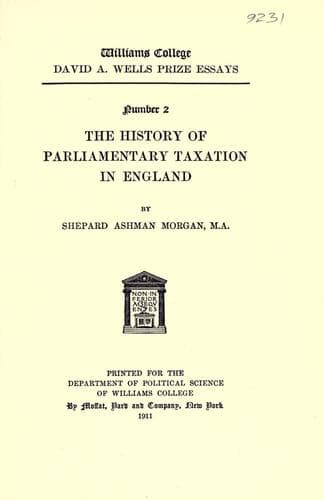
The History of Parliamentary Taxation in EnglandMorgan, Shepard Ashman
History
The History of Parliamentary Taxation in England
Morgan, Shepard Ashman
Taxation -- Great Britain; Taxation -- Great Britain -- History
There was no taxation in the reign of Edward I, except as the clergy
taxed the people for the prosecution of the crusade, until Edward
called his first Parliament on the 22d April, 1275, at Westminster.
The composition of the assemblage is uncertain; the implication
of the Chronicler is that it was a Parliament of magnates,[124]
but the introductory clause of the Statute of Westminster has it
otherwise.[125] “These be the Acts of King Edward ...” it says, “by
his council and by the assent of archbishops, bishops, abbots, priors,
earls, barons and the community of the realm being thither assembled.”
The Statute of Westminster, which was composed of some fifty-one
articles, included a provision for regulating the feudal aids which
were required upon the knighting of the lord’s son or on the event of
the marriage of his daughter. Twenty shillings on the knight’s fee
and twenty shillings from each parcel of land held in socage yielding
twenty pounds annually, were to be the maximum rates thereafter.
[A custom on wool]
The great advantages gained by the nation under the Statute of
Westminster were not won without a price. The same Parliament made a
grant of a custom on wool, woolfells, and leather.[126] The parties
to the grant were essentially the same as those who registered their
assent in the preamble of the statute; there was, however, this
singular difference, that it was done “at the instance and request of
the merchants.” The amount levied was “a half-mark from each sack of
wool, and a half-mark from each three hundred woolfells, which make a
sack, and one mark from each last of leather, exported from the realm
of England,” etc.
Public-domain text, read in full here on John Shaqi.
Reviews
Reviews
No reviews yet
Be the first to share your thoughts on this work.
Join the Discussion
Join the discussion
Sign in to leave a comment or review.
Sign InorCreate an account