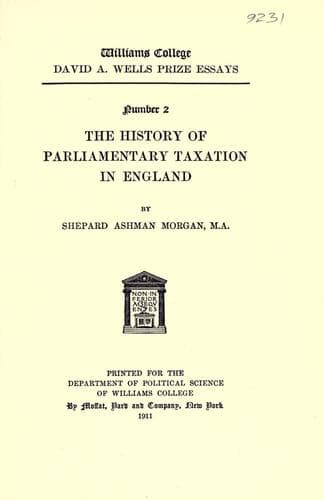
The History of Parliamentary Taxation in EnglandMorgan, Shepard Ashman
History
The History of Parliamentary Taxation in England
Morgan, Shepard Ashman
Taxation -- Great Britain; Taxation -- Great Britain -- History
The importance, both in a forward view and in retrospect of this
grant of a wool custom, is very great. Parliament in granting this
custom assumed the power of assenting to a tax which previously had
been considered within the peculiar province of the king. It made a
definite statement of what was to be taken subsequently as the legal
rate of duty chargeable upon exports of wool. The rate, which since
the beginning of the century had been agreed upon between royal
officers and merchants as their reasonable charge was this half mark
(6_s._ 8_d._) on each sack of wool weighing 364 pounds, or on the
estimated equivalent of a sack, 300 woolfells, and a mark upon each
last (or load) of leather.[127] Exactions above this rate were known
as _mala tolta_, the evil tolls, and the phrase had been shortened to
the single word maletolt. The forty-first chapter of Magna Carta had
promised to all merchants freedom “from all evil tolls,” though it
continued the “ancient and right customs.” Apparently, however, Henry
III with respect to this clause as in many another similar instance,
did not deem himself bound to adhere scrupulously to his promise.
The Parliament of Edward I at Westminster in 1275 settled the matter;
the “great and ancient custom” on wool was legally determined, and
thereafter a larger exaction would be regarded as illegal.[128]
[Edward’s Second Parliament, 13th October, 1275]
Edward summoned a second Parliament for the 13th October following in a
manner which gives ground for the presumption that the presence of the
knights of the shire in a parliament designed primarily for the raising
of money, was already becoming a custom. The point cannot be better
illustrated than by a translation of the writ itself.[129] “Since we
have bidden the prelates and magnates of our realm,” so it goes, “to
be present at our Parliament which we will hold ... at Westminster, to
treat with us both concerning the condition of our realm and of certain
of our business which we will declare to them at the same time, and
as it is expedient that two knights from the county above-mentioned be
present at the same Parliament from the body of discreet and lawful
knights of the same county, by the reasons above-stated we command
you that you cause to be elected in your full county-court (in pleno
comitatu) by the assent of the same county, the said two knights and
that you cause them to come to us at Westminster in behalf of the
community of the said county on the said day, to treat with us and
with the above-mentioned prelates and magnates about the above-stated
business. And omit none of it.”
[Sidenote Attendance of Knights of the Shire “expedient” for uses of
taxation]
Public-domain text, read in full here on John Shaqi.
Reviews
Reviews
No reviews yet
Be the first to share your thoughts on this work.
Join the Discussion
Join the discussion
Sign in to leave a comment or review.
Sign InorCreate an account