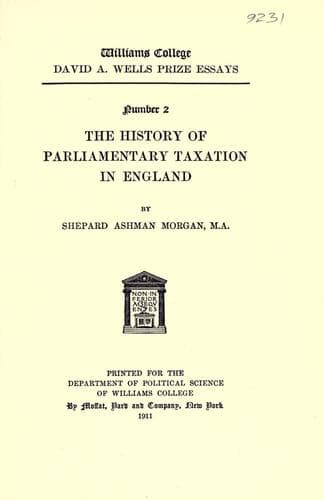
The History of Parliamentary Taxation in EnglandMorgan, Shepard Ashman
History
The History of Parliamentary Taxation in England
Morgan, Shepard Ashman
Taxation -- Great Britain; Taxation -- Great Britain -- History
The following spring Edward married his younger daughter to the Earl
of Gloucester and besought Parliament for an aid “pur fille marier,”
though technically this was to be paid only in the case of the marriage
of the king’s eldest daughter. Parliament proved well-disposed,
however, and granted forty shillings on the fee. The manner in which
the barons and bishops who composed this session of Parliament
made their offering is noteworthy, in view of the fact that the
tenants-in-chief intimated that they could speak only for themselves.
They made their own grant of an aid and extended it “as far as in them
lies,” to “the community of the whole kingdom.”[142] The barons made
special note of the fact that the offering was an advance upon the two
marks which had been granted to King Henry, and stipulated that this be
not drawn into precedent. As a matter of fact, the tax fell only on the
tenants-in-chief (just why can only be conjectured), and the collection
was not made until many years afterward.
A second Parliament was held in July. To it Edward summoned two or
three elected knights from each shire.[143] The design behind the
calling of the Parliament was probably the securing of a grant of a
fifteenth of temporal movables, since it develops that such a tax
was laid at that session, by clergy and laity alike.[144] Edward
made a further demand of a tenth of spiritual revenue, which the
clergy granted him on the 2d October following.[145] Apparently these
offerings to the king were in payment for his banishment of the Jews,
who were hated for their usurious habits and for their religion; the
laity sought their expulsion for the former reason and the clergy
ostensibly for the latter, but the offence to their pockets doubtless
did much to arouse their religious zeal against the Jews.
The interval between 1290 and 1294 does not furnish a wealth of
material. The royal poverty coexisted with a spirit of restlessness
on the borders and in France during the four years, and little was
accomplished toward relieving either the one or the other. In 1291
the Pope had complicated Edward’s relations with the English clergy
by giving him a tenth of spiritual revenue for six years,[146] and
the barons holding estates in Wales gave a fifteenth in 1292. Edward
also had recourse to distraint of knighthood, which as in 1282 was
symptomatic of a straitened treasury.[147]
[Seizure of wool, 1294]
Public-domain text, read in full here on John Shaqi.
Reviews
Reviews
No reviews yet
Be the first to share your thoughts on this work.
Elsewhere in the archive
Join the Discussion
Join the discussion
Sign in to leave a comment or review.
Sign InorCreate an account