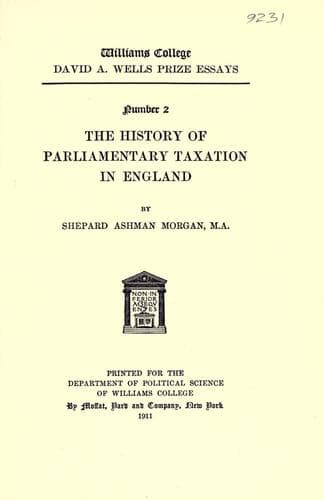
The History of Parliamentary Taxation in EnglandMorgan, Shepard Ashman
History
The History of Parliamentary Taxation in England
Morgan, Shepard Ashman
Taxation -- Great Britain; Taxation -- Great Britain -- History
same, “to hear and to do those things which we on our part will cause
to be shown to them.”[135] The clergy also were summoned; the bishops
were to bring their archdeacons, the heads of religious houses, and the
proctors of the cathedral clergy.
[They make grants of taxes]
These irregular assemblies convened as they were bidden, the clergy and
laity meeting separately. The knights and burgesses at Northampton made
a grant of a thirtieth on condition that the barons do likewise;[136]
the clergy refused to make any offering at all because the parochial
clergy were not represented. At York, the knights and burgesses made
the grant of a thirtieth without condition; the clergy made promises
which they did not keep. When the collection was made, allowances
were admitted for the sums which had been contributed upon private
negotiation. Notwithstanding the irregular character of these Councils
in view of later developments,--irregular in that the parochial clergy
and the baronage were not represented and that the meeting was not in
a single general assembly,--they marked the “transition from local to
that of central assent to taxation.”[137] The king had discovered that
it was easier to attain his end through a Parliament than by private
solicitation,--that is, if he were to wait for the assent of the people
at all. It was a step on the road; Edward had decided in favor of
summoning a Parliament as against asking for money from individuals. It
was more profitable.
[Parliaments of 1289 and 1290]
There is no further record of taxation until 1289, save that of a grant
in 1288 from Nicholas IV, of an ecclesiastical tenth for six years in
reward of Edward’s vow to undertake a crusade,[138] and a scutage in 1285
on account of the Welsh campaign of three years before.[139] Edward’s
expenses, on the other hand, were heavy. The prosecution of his foreign
interests in Gascony, where he had been in person for three years, was a
heavy drain upon the exchequer. At the Parliament of 1289 the treasurer,
John Kirkby, laid the royal needs before the barons, who responded that
they would not pay “until they should see the king’s face in his own
land.”[140] Kirkby began to tallage the cities and boroughs and the
other demesne lands of the king, “imposing upon them an intolerable sum
of money.” It is probable that this as well as other royal tallages
applied only to such of the cities and boroughs as were included in the
royal demesne. As a matter of fact, most of the boroughs were included
in the demesnes of the king.[141]
Public-domain text, read in full here on John Shaqi.
Reviews
Reviews
No reviews yet
Be the first to share your thoughts on this work.
Elsewhere in the archive
Join the Discussion
Join the discussion
Sign in to leave a comment or review.
Sign InorCreate an account