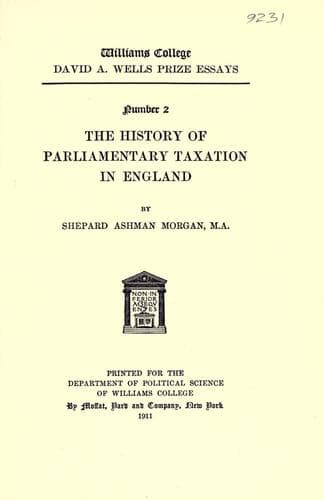
The History of Parliamentary Taxation in EnglandMorgan, Shepard Ashman
History
The History of Parliamentary Taxation in England
Morgan, Shepard Ashman
Taxation -- Great Britain; Taxation -- Great Britain -- History
The commons perceived, apparently, that the incidence of indirect
taxation fell upon the nation quite to the same degree as direct
taxation. The customs, in the beginning undisputedly within the royal
prerogative, and according to royalistic advocates unceasingly so up
to relatively modern times, were contended for almost as heartily as
power over direct taxation itself. “The history of the customs,” says
Bishop Stubbs, “illustrates the pertinacity of the commons as well as
the evasive policy of the supporters of prerogative.”[224] Prior to
the accession of Edward III, the struggle for control, centering upon
exactions in excess of the _antiquæ custumæ_, was quietly waged between
king and Parliament. During his reign and afterward the watchfulness of
Parliament kept up.
[Checkered history of the wool customs]
After the legislation of 1340, Parliament showed itself willing to
bargain with the king for control of the customs duties, thus staying
within its legal rights. It could only petition, it could not yet
enforce; and when the king promised his assent to a petition he
frequently forgot his word. An account of what became of the custom
on wool is illuminating as indicative of the variation between
petition and enforcement. In 1340, the king had received by grant of
Parliament forty shillings on the sack, for a year and a half, on the
understanding that he would abolish the maletolt. After a lapse of two
years,[225] Edward procured from the merchants without the consent of
the commons, a custom of forty shillings on the sack and issued orders
for its collection. The commons, exhibiting more than an elementary
knowledge of economic principles, perceived that the tax fell not upon
the foreign merchants, but upon the growers of wool. In response to the
remonstrance of the commons made in the Parliament of May, 1343, Edward
declared to them that the price to be paid for wool, being fixed by
the authority of Parliament, would be constant, and that consequently
the foreign merchants would feel the incidence of the tax.[226] The
commons, duly impressed by so subtle an argument, consented to a
reimposition of the exaction for three years under the sanction of
Parliament. After the passing of the three years, and the ordinance
fixing the price of wool having in the meantime been revoked,[227]
the commons, finding that Edward showed no disposition to release
wool from the custom, petitioned against its continuance.[228] The
king replied that he had secured the assent of the baronage and of
the merchants, and that he had already pledged the proceeds of it to
his creditors. The commons, finding that they could not win their
point, contented themselves with a belief that having established
the principle, they could at any time demand a practice of it, and
granted the perpetuation of the old rate for two years. In 1348, at the
conclusion of that term, the commons again presented a remonstrance,
asserting that the wool subsidy was really a land tax.
Public-domain text, read in full here on John Shaqi.
Reviews
Reviews
No reviews yet
Be the first to share your thoughts on this work.
Elsewhere in the archive
Join the Discussion
Join the discussion
Sign in to leave a comment or review.
Sign InorCreate an account