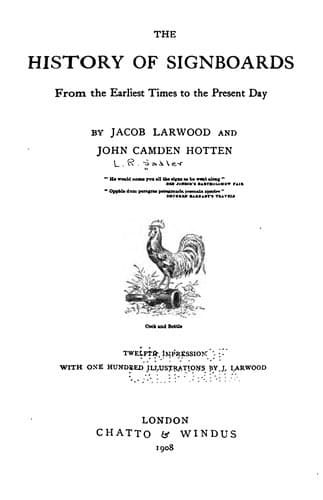
The History of Signboards, from the Earliest times to the Present DayHotten, John Camden
History
The History of Signboards, from the Earliest times to the Present Day
Hotten, John Camden
Inn signs -- England -- History; Signs and signboards -- History
In pondering over this class of signs great difficulty often arises from
the absence of all proof that the object under consideration was set up
as a badge, and not as a representation of the actual animal. As no
amount of investigation can decide this matter, we have been somewhat
profuse in our list of badges, in order that the reader should be able
to form his own opinion upon that subject. Thus, for instance, with the
first sign that offers itself, the ANGEL AND TRUMPET, it is impossible
to say whether the supporters of Richard II. gave rise to it, or whether
it represents Fame. Various examples of it still occur, and a very good
carved specimen may be seen above a draper’s shop in Oxford Street. It
is also the name of alehouses in King Street, Holborn, and in Stepney,
High Street, &c.
The ANTELOPE is not very common now, although in 1664 there was a tavern
with this sign in W. Smithfield, the trades token of this house bearing
the following legend:--BIBIS. VINUM. SALUTA. ANTELOP. The Rev. John Ward
tells a very feeble college joke concerning the Antelope Tavern in
Oxford:--
“I have heard of a fellow at Oxford, one Ffrank Hil by name, who kept
the Antelope; and if one yawned, hee could not chuse but yawne, that
vppon a time some schollars hawing stoln his ducks, hee had them to
the Vice chancelor, and one of the scholars got behind the Vice
chancelor, and when the fellow beganne to speak hee would presently
fall a yawning, insomuch that the Vice chancelor turned the fellow
away in great indignation.”[133]
Macklin, the centenarian comedian, who died in 1797, used for thirty
years and upwards to visit a public-house called the Antelope in White
Hart yard, Covent Garden, where his usual beverage was a pint of stout
made hot and sweetened almost to a syrup. This, he said, balmed his
stomach, and kept him from having any inward pains.[134] He died at the
age of upwards of 107, a proof that if, as the teetotallers inform us,
fermented liquors be a poison, it is certainly a slow one.
The DRAGON appears to have been one of the oldest heraldic charges of
this kingdom. It was the standard of the West Saxons, and continued so
until the arrival of William the Conqueror, for in the Bayeux tapestry a
winged dragon on a pole is constantly represented near the person of
King Harold. It was likewise the supporter of the royal arms of Henry
VII. and all the Tudor sovereigns except Queen Mary. Before that time it
had been borne by some of the early Princes of Wales, and also by
several of the kings. Thus it is recorded, 28 Hen. III., the king
ordered to be made--
“Unum draconem in modum unius vexilli de quodam rubro sanulo, qui
ubique sit de auro extensillatus, cujus lingua sit facta tamquam ignis
comburens et continue appareat moveatur, et ejus oculi fiant de
sapphiris vel de aliis lapidibus eidem convenientibus.”[135]
At the battle of Lewes, 1264, the chronicler says that--
Public-domain text, read in full here on John Shaqi.
Reviews
Reviews
No reviews yet
Be the first to share your thoughts on this work.
Elsewhere in the archive
Join the Discussion
Join the discussion
Sign in to leave a comment or review.
Sign InorCreate an account