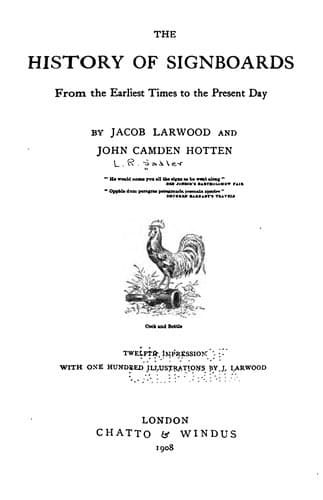
The History of Signboards, from the Earliest times to the Present DayHotten, John Camden
History
The History of Signboards, from the Earliest times to the Present Day
Hotten, John Camden
Inn signs -- England -- History; Signs and signboards -- History
Amongst the oldest inns which bore this sign, the White Hart, in the
High Street, Borough, ranks foremost in historical interest. Here it was
that Jack Cade established his headquarters, July 1, 1450. “And you,
base peasants, do ye believe him? Will you needs be hanged with your
pardons about your necks? Hath my sword therefore broken through London
gates, that ye should leave me at the White Hart in Southwark.”--_Henry
VI._, p. ii. a. 1. s. 8. In the yard of that inn he beheaded “one
Hawaydyne of Sent Martyns.”[141] Many and wild must have been the scenes
of riot and debauchery enacted in this place during the stay of the
reckless rebel. The original inn that had sheltered Cade and his
followers, remained standing till 1676, when it was burnt down in the
great fire that laid part of Southwark in ashes. It was rebuilt, and the
structure is still in existence; in Hatton’s time (1708) it could boast
of the largest sign in London except one, which was at the Castle Tavern
in Fleet Street. Charles Dickens has immortalised the White Hart Inn, by
a most lifelike description in his “Pickwick Papers.”
The White Hart Tavern, in Bishopsgate, is also of very respectable
antiquity. It has the date 1480 in the front. Standing on the boundary
of the old hospital of Bethlehem, it is probable that this building
formed part of that religious house. Doubtless it was the hostelry or
inn for the entertainment of strangers, which was a usual outbuilding
belonging to the great hospitals in those days.
In the reign of Queen Elizabeth there was a White Hart Inn in the
Strand, mentioned in a copy of an indenture of lease, from the Earl of
Bedford to Sir William Cecil (7th September 1570) of a portion of
pasture in Covent Garden, “beinge thereby devyeded from certayne gardens
belonginge to the Inne called the Whyte Heart, and other Tenements
scituate in the high streate of Westm’ comunly called the Stronde.” It
is not improbable that this inn gave its name to Hart Street and White
Hart Yard, in that neighbourhood.
Public-domain text, read in full here on John Shaqi.
Reviews
Reviews
No reviews yet
Be the first to share your thoughts on this work.
Elsewhere in the archive
Join the Discussion
Join the discussion
Sign in to leave a comment or review.
Sign InorCreate an account