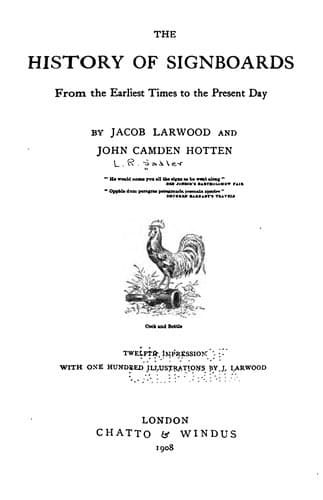
The History of Signboards, from the Earliest times to the Present DayHotten, John Camden
History
The History of Signboards, from the Earliest times to the Present Day
Hotten, John Camden
Inn signs -- England -- History; Signs and signboards -- History
Another crest of the Derby family also occurs as a sign--namely, the
EAGLE’S FOOT, which was adopted in the sixteenth century by John
Tysdall, a bookseller at the upper end of Lombard Street.
The frequency of eagles in heraldry made them very common on the
signboard, although it is now impossible to say whose armorial bearings
each particular eagle was intended to represent. The SPREAD EAGLE occurs
as the sign of one of the early printers and booksellers, Gualter Lynne,
who, in the middle of the sixteenth century, had two shops with that
sign,--one on Sommer’s Key, near Billingsgate, and another next St
Paul’s Wharf. In 1659 there was a BLACK SPREAD EAGLE at the west end of
St Paul’s, which shop was also a bookseller’s, one Giles Calvert. As the
signs in large towns and cities were generally not altered when the
house changed hands, it is not improbable but that this may be the same
Black Eagle mentioned by Stow in the following words:--
“During a great tempest at sea, in January 1506, Philip, King of
Castille, and his queen, were weather-driven at Falmouth. The same
tempest blew down the Eagle of brass off the spire of St Paul’s Church
in London, and in the falling the same eagle broke and battered the
Black Eagle that hung for a sign in St Paul’s Churchyard.”
Milton’s father, a scrivener by trade, lived in Bread Street,
Cheapside, at the sign of the Spread Eagle, which was his own coat of
arms, and in this house the great author of “Paradise Lost” was born,
December 9, 1608. When the poet’s fame had gone forth, strangers used to
come to see the house, until it was destroyed by the fire of 1666.
Perhaps its memory is preserved in Black Spread Eagle Court, which is
the name of a passage in that locality.
Another Spread Eagle was a noted “porter-house” in the Strand at the end
of the last century:--
“And to some noted porter-house repair;
The several streets or one or more can claim,
Alike in goodness and alike in fame.
The Strand her Spreading Eagle justly boasts.
* * * * *
Facing that street where Venus holds her reign,
And Pleasure’s daughters drag a life of pain,[184]
There the Spread Eagle, with majestic grace,
Shows his broad wings and notifies the place.
* * * * *
There let me dine in plenty and in quiet.”[185]
The GRASSHOPPERS on the London signboards were all descendants of Sir
Thomas Gresham’s sign and crest, which is still commemorated by the
weather-vane on the Royal Exchange, of which he was the first founder.
The original sign appears to have been preserved up to a very recent
date.
Public-domain text, read in full here on John Shaqi.
Reviews
Reviews
No reviews yet
Be the first to share your thoughts on this work.
Elsewhere in the archive
Join the Discussion
Join the discussion
Sign in to leave a comment or review.
Sign InorCreate an account