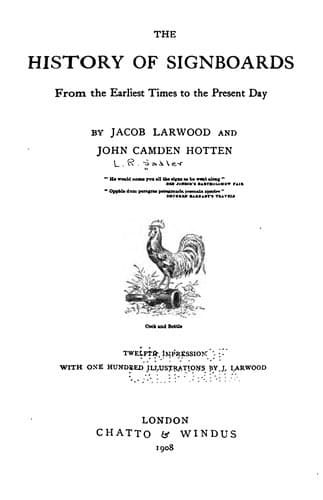
The History of Signboards, from the Earliest times to the Present DayHotten, John Camden
History
The History of Signboards, from the Earliest times to the Present Day
Hotten, John Camden
Inn signs -- England -- History; Signs and signboards -- History
“Maister Hobson having one of his Prentices new come out of his time,
and being made a free man of London, desired to set up for himself;
so, taking a house not far from St Laurence Lane, furnished it with
store of ware, and set up the signe of the Maydenhead; hard by was a
very rich man of the same trade, had the same signe, and reported in
every place where he came, that the young man had set up the same
signe that he had onely to get away his customers, and daily vexed the
young man therewithall, who, being grieved in his mind, made it known
to Maister Hobson, his late Maister, who, comming to the rich man,
said, ‘I marvell, sir,’ (quoth Maister Hobson,) ‘why you wrong my man
so much as to say he seketh to get away your customers.’ ‘Marry, so he
doth,’ (quoth the other,) ‘for he has set up a signe called the
Maidenhead, and mine is.’ ‘That is not so,’ (replied Maister Hobson,)
‘for his is the widdoe’s head, and no maydenhead, therefore you do him
great wrong.’ The rich man hereupon, seeing himself requited with
mocks, rested satisfied, and never after that envied Maister Hobson’s
man, but let him live quietly.”[189]
This sign occurs occasionally as the MAID’S HEAD, but since Queen
Elizabeth’s reign it has doubtless frequently referred to the virgin
queen.
THE CROSS FOXES--_i.e._, two foxes counter saliant--is a common sign in
some parts of England. It is the sign of the principal inn at Oswestry
in Shropshire, and of very many public-houses in North Wales, and has
been adopted from the armorial bearings of Sir Watkin Williams Wynne,
Bart., whose family hold extensive possessions in these parts. The late
baronet, too, made himself very popular as a patron of agricultural
improvements. Old Guillim, the heraldic writer’s remarks upon this coat
of arms, which he says belongs to the Kadrod Hard family of Wales, are
quaint:--
“These are somewhat unlike Samson’s foxes that were tied together by
the tails, and yet these two agree in _aliquo tertio_: They came into
the field like to enemies, but they meant nothing less than fight, and
therefore they pass by each other, like two crafty lawyers, which come
to the Bar as if they meant to fall out deadly about their clients’
cause; but when they have done, and their clients’ purses are well
spunged, they are better friends than ever they were, and laugh at
those geese that will not believe them to be foxes, till they (too
late) find themselves foxbitten.”[190]
Public-domain text, read in full here on John Shaqi.
Reviews
Reviews
No reviews yet
Be the first to share your thoughts on this work.
Elsewhere in the archive
Join the Discussion
Join the discussion
Sign in to leave a comment or review.
Sign InorCreate an account