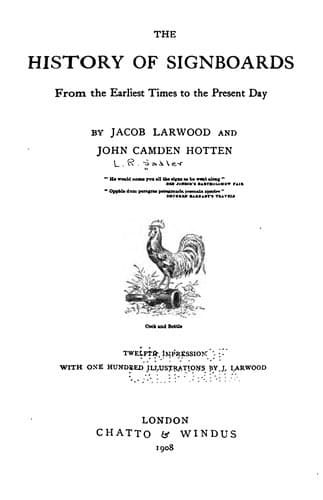
The History of Signboards, from the Earliest times to the Present Day — John Shaqi
The History of Signboards, from the Earliest times to the Present DayHotten, John Camden
History
The History of Signboards, from the Earliest times to the Present Day
Hotten, John Camden
Inn signs -- England -- History; Signs and signboards -- History
The BIBLE AND DOVE, _i.e._, the Holy Ghost, was the sign of John Penn,
bookseller, over against St Bride’s Church, Fleet Street, 1718; and the
BIBLE AND PEACOCK, the sign of Benjamin Crayle, bookseller, at the west
end of St Paul’s, in 1688. If not a combination of two signs, the bird
may have been added on account of its being the type of the
Resurrection, in which quality it is found represented in the Catacombs,
a symbolism arising from the supposed incorruptibility of its
flesh.[369] Various other combinations occur, as the BIBLE AND KEY.
Rowland Hall, a printer of the sixteenth century, had for his sign the
HALF EAGLE AND KEY, (see Heraldic Signs,) of which the Bible and Key may
be a free imitation. It was the sign of B. Dod, bookseller, in Ave Maria
Lane, 1761; whilst the GOLDEN KEY AND BIBLE was that of L. Stoke, a
bookseller at Charing Cross, 1711. The “Bible and Key” is also the name
of a certain Coscinomanteia, somewhat similar to the Sortes Virgilianæ.
This method of divination was performed in two ways, in the first,
(stated by Matthew of Paris to have been frequently practised at the
election of bishops,) the Bible was opened on the altar, and the
prediction taken from the chapter which first caught the eye on opening
the book; the other was by placing two written papers, one negative, the
other affirmative, of the matter in question, under the pall of the
altar, which, after solemn prayers, was believed would be decided by
divine judgment. Gregory of Tours mentions another method by the
Psalms.[370]
At the present day “Bible and Key” divinations are often attempted by
those who believe in fortune-telling and vaticinations. The method
adopted is as follows:--A key is placed, with the bow or handle sticking
out, between the leaves of a Bible, on Ruth i. 16:
“And Ruth said, Intreat me not to leave thee, or to return from
following after thee: for whither thou goest, I will go; and where
thou lodgest, I will lodge; thy people shall be my people, and thy God
my God.”
The Bible is then firmly tied up, most effectually with a garter, and
balanced by the bow of the key on the fore-fingers of the right hands of
two persons, the one who wishes to consult the oracle, the other any
person standing near. The book is then addressed with these
words--“Pray, Mr Bible, be good enough to tell me if ---- or not?” If
the question be answered in the affirmative the key will swing round,
turn off the finger, and the Bible fall down; if in the negative, it
will remain steady in its position. Not only upon matrimonial, but upon
all sorts of questions, this oracle may be consulted.
Public-domain text, read in full here on John Shaqi.
Reviews
Reviews
No reviews yet
Be the first to share your thoughts on this work.
Elsewhere in the archive
Join the Discussion
Join the discussion
Sign in to leave a comment or review.
Sign InorCreate an account