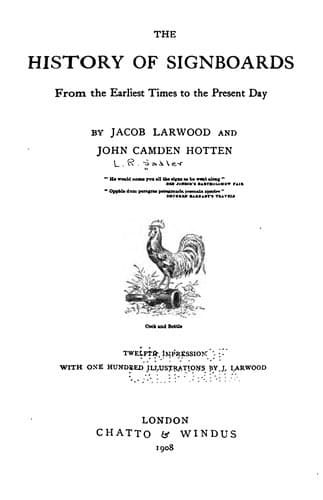
The History of Signboards, from the Earliest times to the Present DayHotten, John Camden
History
The History of Signboards, from the Earliest times to the Present Day
Hotten, John Camden
Inn signs -- England -- History; Signs and signboards -- History
[390] Even in the most remote periods of history _three_ was considered
a mystic number, and regarded with reverence. The Assyrians had their
triads. In Ancient Egypt every town or district had its own triad, which
it worshipped, and which was a union of certain attributes, the third
member proceeding from the other two. Sir Gardiner Wilkinson, in his
“Ancient Egyptians,” vol. iv., ch. xii., p. 230, mentions a stone with
the words “one Bail, one Athor, one Akori, hail father of the world,
hail triformous God.” Thoms, in his “Dissertation on Ancient Chinese
Vases,” says:--“The Chinese have a remarkable preference for the number
three; they say one produced two, two produced three, and three produced
all things. There is something remarkable in this last phrase; perhaps
it conveys an indistinct idea of the Trinity. The Buddhists, who are of
modern date in China, use the term ‘the three precious ones’--‘the Deity
that has ruled, the ruling Deity, and the Deity that shall rule.’ The
Taore sect have also their ‘three pure ones.’ The number three has many
associations, as the three bonds--a prince and minister, father and son,
husband and wife; the three superintendents--the treasurer, judge, and
collector of customs; the three powers--heaven, earth, and man,” &c. In
the Hindoo religion combinations of three are equally frequent: they
have several trimustis or trinities; three principal deities, Brahma,
Vishnu, and Mahadeva; another triad is Brahma, Vishnu, and Siva, or
matter, spirit, and destruction; there are three plaited locks on the
head of Radha, representing a mystical union of three principal rivers,
Ganges, Yamuna, and Sarawati. Siva has three eyes; the sun is called
three-bodied; the triangle with the Hindoos is a favourite type for the
triune co-equality, hence the pentagram (a figure composed of two
equilateral triangles, placed with the apex of the one towards the base
of the other, and so forming six triangles by the intersections of their
sides) is in great favour with them; further, they use three mystic
letters to denote their deity; have 3 × 7 hells, (seven is also a mystic
number with them and other ancient races,) and many other combinations
of three. The same preference for this number is observable in the Greek
and Roman mythology, which mentions three theocraties, three graces,
three fates, three harpies, three syrens, three heads of Cerberus, three
eggs of Leda, &c. And, taking 3 as a unit, 3 × 3 muses, 3 × 4 principal
gods, (Dii Majores,) 3 × 4 labours of Hercules, &c.
[391] _London Gazette_, Nov 8 to 11, 1680.
[392] Cunningham’s Handbook to London, p. 470.
[393] Soap, wax, tallow, and similar articles were part of the
merchandise in which the Hanse merchants dealt.
[394] _Kingdom’s Intelligencer_, April 6-13, 1663.
[395] Stow’s Survey of London.
Public-domain text, read in full here on John Shaqi.
Reviews
Reviews
No reviews yet
Be the first to share your thoughts on this work.
Elsewhere in the archive
Join the Discussion
Join the discussion
Sign in to leave a comment or review.
Sign InorCreate an account