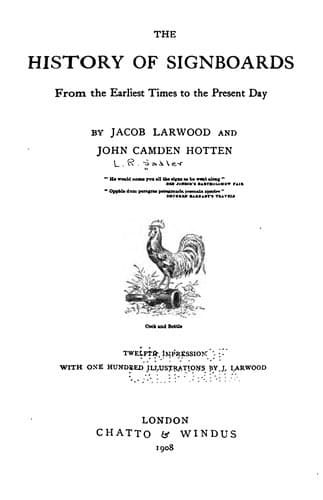
The History of Signboards, from the Earliest times to the Present DayHotten, John Camden
History
The History of Signboards, from the Earliest times to the Present Day
Hotten, John Camden
Inn signs -- England -- History; Signs and signboards -- History
Some favourites of the signboard have, however, been more fortunate than
others. HENRY VIII., for instance, may still be seen in many places;
indeed, for more than two centuries after his death, almost every KING’S
HEAD invariably gave a portrait of Bluff Harry.
Older kings occasionally occur, but their memories seem to have been
revived rather than handed down by successive innkeepers. If we are to
believe an old Chester legend, however, THE KING EDGAR INN, in Bridge
Street of that city, has existed by the same name since the time of the
Saxon king. The sign represents King Edgar rowed down the river Dee by
the eight tributary kings. The present house has the appearance of being
built anterior to the reign of Elizabeth, and the sign looks almost as
old, but it would be unwise to give the place or the sign a much higher
antiquity. KING JOHN is the sign under whose auspices Jem Mace, the
pugilist, keeps a public-house in Holywell Lane, Shoreditch. The same
king also figures in Albemarle Street and in Bermondsey; whilst the
great event of his reign, MAGNA CHARTA, is a sign at New Holland, Hull.
JOHN OF GAUNT may be seen in many places; and we may surmise that his
upholders are stanch Protestants, who value his character as a reformer
and supporter of Wicliffe. The BLACK PRINCE may not unlikely have come
down to us in an uninterrupted line of signboards; so little was his
identity sometimes understood, that there is a shop-bill in the “Banks
Collection”[56] on which this hero is represented as a negro!
There is a QUEEN ELEANOR in London Fields, Hackney, probably the
beautiful and affectionate queen of Edward I., buried in Westminster
Abbey, 1290, in honour of whom Charing Cross, Cheapcross, and seven
other crosses, were erected on the places where her body rested on its
way to the great Abbey. What prompted the choice of this sign it is hard
to say.
At Hever, in Kent, a rude portrait of Henry VIII. may be seen. Near this
village the Bolleyn or Bullen family formerly held large possessions;
and old people in the district yet shew the spot where, as the story
goes, King Henry often used to meet Sir Thomas Bolleyn’s daughter Anne.
Be this as it may, years after the unhappy death of Anne, the village
alehouse had for its sign, BULLEN BUTCHERED; but the place falling into
new hands, the name of the house was altered to the BULL AND BUTCHER,
which sign existed to a recent date, and would probably have swung at
this moment, but for a desire of the resident clergyman to see something
different. He suggested the KING’S HEAD; and the village painter was
forthwith commissioned to make the alteration. The latter accepted the
task, drew the bluff features of the monarch, and represented it as
other King’s Heads, but in his hands placed a large axe, which signboard
exists to this day.
Public-domain text, read in full here on John Shaqi.
Reviews
Reviews
No reviews yet
Be the first to share your thoughts on this work.
Join the Discussion
Join the discussion
Sign in to leave a comment or review.
Sign InorCreate an account