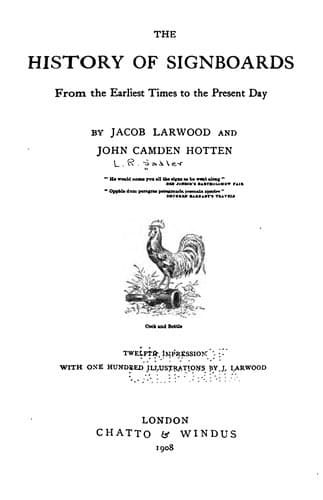
The History of Signboards, from the Earliest times to the Present DayHotten, John Camden
History
The History of Signboards, from the Earliest times to the Present Day
Hotten, John Camden
Inn signs -- England -- History; Signs and signboards -- History
As Byron hints, popular admiration is generally very short-lived; and
when a fresh hero is gazetted, the next new alehouse will most probably
adopt him for a sign in preference to the last great man. Thus it is
that even the Duke of Wellington is now neglected, and in his place we
see General Havelock, Sir Colin Campbell, Lord Palmerston, and Mr
Gladstone, the Chancellor of the Exchequer, not omitting the fair
Princess of Denmark. We will not now dwell upon these modern
celebrities, but rather direct our attention to those illustrious dead
upon whom the signboard honours were bestowed in bygone ages.
Many signboards have an historic connexion of some sort with the place
where they are exhibited. Thus the ALFRED’S HEAD, at Wantage, in
Berkshire, was in all probability chosen as a sign because Wantage was
the birthplace of King Alfred. So the CANUTE CASTLE, at Southampton,
owes its existence to a local tradition; whilst admiration for the great
Scotch patriot made an innkeeper in Stowell Street, Newcastle, adopt SIR
WILLIAM WALLACE’S ARMS. The CÆSAR’S HEAD was, in 1761, to be seen near
the New Church in the Strand,[54] and, in the beginning of this century,
was the sign of a tavern in Soho, which afterwards removed to Great
Palace Yard, Westminster. Even at the present day, his head may be seen
outside certain village alehouses; but this we may attribute to that
provincial popularity which the Roman hero shares with Oliver Cromwell;
for as the Protector gets the blame of having made nearly all the ruins
which are to be found in the three kingdoms, so Cæsar is generally named
by country people as the builder of every old wall or earthwork the
origin of which is unknown.
Notwithstanding the popular censure, CROMWELL is still honoured with
signboards in places where his memory has lingered, as at Kate’s Hill,
near Dudley.
In most cases, however, signboard popularity is rather short-lived;
“_dulcique animos novitate tenebo_” seems to be essentially the motto of
those that choose popular characters for their sign. Had this modern
tribute of admiration been in use at the time of the Preacher, it might
have afforded him one more illustration of the vanity of vanities to be
found in all sublunary things. Horace Walpole noticed this fickleness of
signboard fame in one of his letters:--
“I was yesterday out of town, and the very signs, as I passed through
the villages, made me make very quaint reflections on the mortality of
fame and popularity. I observed how the Duke’s Head had succeeded
almost universally to Admiral Vernon’s, as his had left but few traces
of the Duke of Ormond’s. I pondered these things in my breast, and
said to myself, ’Surely all glory is but as a sign!’”[55]
Public-domain text, read in full here on John Shaqi.
Reviews
Reviews
No reviews yet
Be the first to share your thoughts on this work.
Join the Discussion
Join the discussion
Sign in to leave a comment or review.
Sign InorCreate an account