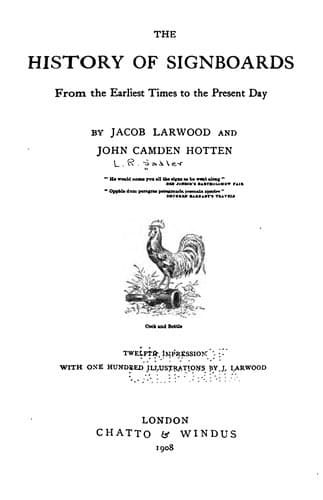
The History of Signboards, from the Earliest times to the Present DayHotten, John Camden
History
The History of Signboards, from the Earliest times to the Present Day
Hotten, John Camden
Inn signs -- England -- History; Signs and signboards -- History
As for QUEEN ELIZABETH, she was the constant type of the Queen’s Head,
as her father was of the King’s Head; and, like him, she may still be
seen in many places. It is somewhat more difficult to ascertain who is
meant by the QUEEN CATHERINE in Brook Street, Ratcliffe Highway; whether
it be Queen Catherine of Aragon, or Queen Catherine of Braganza. QUEEN
ANNE, in South Street, Walworth, has evidently come down to us as the
token of that house since the day of its opening, just as the QUEEN OF
BOHEMIA, who, until about fifty years ago, continued as a sign in Drury
Lane.[57] This was Elizabeth, daughter of James I., married to Frederic
V., Elector-Palatine, who, after her husband’s death, lived at Craven
House, Drury Lane, and died there, February 13, 1661, having been
privately married, it is thought, to Lord Craven, who was foremost in
fighting the battles of her husband.
Of KING’S HEADS, Henry VIII. is the oldest on authentic record. But
this does not prove that he was the first; for, as there lived great men
before Agamemnon, so most kings during their reign will, in all
probability, have had their signs. Among Henry’s successors, we find the
head of Edward VI. on a trades token; whilst CHARLES THE FIRST’S HEAD
was the portrait hanging from the house of that scoundrel Jonathan Wild,
in the Old Bailey. Even at the present day there is a sign of CHARLES
THE FIRST at Goring Heath, Reading. The MARTYR’S HEAD in Smithfield,
1710, seems also to have been a portrait of Charles I.; so, at least,
the following allusion gives us to understand:--
“May Hyde, near Smithfield, at the Martyr’s Head,
Who charms the nicest judge with noble red,
Thrive on by drawing wines, which none can blame,
But those who in his sign behold their shame;”[58]
which seems to be an allusion to Puritanical water-drinkers. To this
unfortunate king belongs also the sign of the MOURNING BUSH, set up by
Taylor the water-poet over his tavern in Phœnix Alley, Long Acre, to
express his grief at the beheading of Charles I.; but he was soon
compelled to take it down, when he put up the POET’S HEAD, his own
portrait, with this inscription:--
“There is many a head hangs for a sign;
Then, gentle reader, why not mine?”
This “Poeta Aquaticus,” as he sometimes called himself, was a boatman on
the Thames, and alehouse-keeper by profession, besides being the author
of fourscore books of very original poetry. At the same time that he put
up his new sign of the Poet’s Head, he issued a rhyming pamphlet, in
which occur the following lines:--
Public-domain text, read in full here on John Shaqi.
Reviews
Reviews
No reviews yet
Be the first to share your thoughts on this work.
Join the Discussion
Join the discussion
Sign in to leave a comment or review.
Sign InorCreate an account