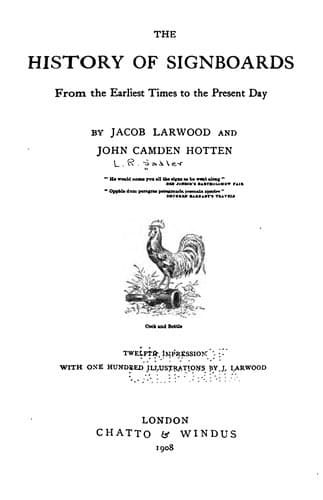
The History of Signboards, from the Earliest times to the Present DayHotten, John Camden
History
The History of Signboards, from the Earliest times to the Present Day
Hotten, John Camden
Inn signs -- England -- History; Signs and signboards -- History
Visits of European monarchs were also commemorated by complimentary
signs. One of the oldest was the KING OF DENMARK, and few kings better
than he deserved the exalted place at the alehouse door; yet, such is
the ingratitude of the world, that he seems now completely forgotten.
The sign originated in the reign of James I., who married a daughter of
Christian IV., King of Denmark. In July 1606, the royal father-in-law
came over on a visit, when the two kings began “bousing” and carousing
right royally, the court, of course, duly following the example. “I came
here a day or two before the Danish king came,” says Sir John
Harrington, “and from that day he did come till this hour, I have been
well-nigh overwhelmed with carousal and sport of all kinds. I think the
Dane has strangely wrought on our English nobles; for those whom I could
never get to taste good liquor, now follow the fashion and wallow in
beastly delights. The ladies abandon their society, and are seen to roll
about in intoxication,” &c.[60] So late as thirty years ago, not less
than three of these signs were left, the most notorious being in the Old
Bailey. It used to be open all night for the sale of creature comforts
to the drunkard, the thief, the nightwalker, and profligates of every
description. Slang was the language of the place, and doubtless the
refreshments were mostly paid for with stolen money. On execution
nights, the landlord used to reap a golden harvest; then there were such
scenes of drunkenness as must have done the old king on the signboard
good to survey, and made him wish to be inside. The visit of another
crowned votary of Bacchus is commemorated by the sign of the CZAR’S
HEAD, Great Tower Street:--
“Peter the Great and his companions, having finished their day’s work,
used to resort to a public-house in Great Tower Street, close to Tower
Hill, to smoke their pipes and drink beer and brandy. The landlord had
the Czar of Muscovy’s Head painted, and put it up for his sign, which
continued till the year 1808, when a person of the name of Waxel took
a fancy to the old sign, and offered the then occupier of the house to
paint him a new one for it. A copy was accordingly made of the
original, which maintains its station to the present day as the Czar
of Muscovy.”[61]
The sign is now removed, but the public-house still bears the same name.
PRINCE EUGENE also was at one time a popular tavern portrait in England,
more particularly after his visit to this country in January 1712. It is
named as one of the signs in Norwich in 1750,[62] but is now, we
believe, completely extinct in England; in Paris there is still one
surviving on the Boulevard St Martin.
Public-domain text, read in full here on John Shaqi.
Reviews
Reviews
No reviews yet
Be the first to share your thoughts on this work.
Join the Discussion
Join the discussion
Sign in to leave a comment or review.
Sign InorCreate an account