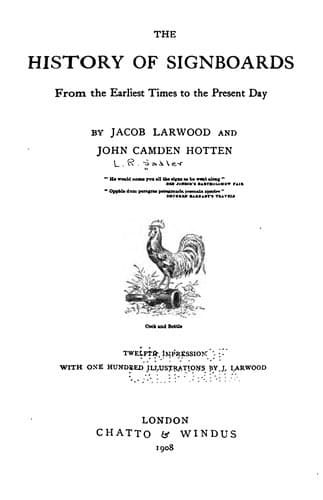
The History of Signboards, from the Earliest times to the Present DayHotten, John Camden
History
The History of Signboards, from the Earliest times to the Present Day
Hotten, John Camden
Inn signs -- England -- History; Signs and signboards -- History
“Lord Craven, in the time of King Charles II., was a constant man at a
fire; for which purpose he always had a horse ready saddled in his
stables, and rewarded the first that gave him notice of such an
accident. It was a good-natured fancy, and he did a good deal of
service; but in that reign everything was turned to a joke. The king
being told of a terrible fire that was broke out, asked if Lord Craven
was there yet. ‘Oh!’ says somebody by, ‘an’t please your majesty, he
was there before it began, waiting for it, he has had two horses burnt
under him already.’[70] On such occasions he usually rode a white
horse, well known to the London mob, which was said to smell the fires
from afar off.”
The EARL OF ESSEX, Elizabeth’s _quondam_ favourite, might have been met
with on many signs long after the Restoration. There are trades tokens
of a shop or tavern with such a sign on the Bankside, Southwark, and
tokens are extant of two other shops that had the ESSEX ARMS. In the
last century there was an ESSEX HEAD in Essex Street; in this tavern the
Robin Hood Society, “a club of free and candid inquiry,” used to meet.
It was originally established in 1613, at the house of Sir Hugh
Middleton, the projector of the New River for supplying London with
water. Its first meetings were held at the houses of members, but
afterwards, the numbers increasing, they removed to the above tavern,
and its name was altered into the “Essex Head Society.” In 1747 it
removed to the Robin Hood in Butcher Row, near Temple Bar. The society
attained a position of so much importance, that a history of its
proceedings was published in 1764, giving an account of the subjects
debated, and reports of some of the speeches. Seven minutes only were
allowed to each speaker, at the expiration of which the _Baker_, or
president, summed up. Many a young politician here winged his first
flight.[71]
In 1784, the year of his death, Dr Johnson instituted at this house a
club of twenty-four members, in order to insure himself society for at
least three days in the week. He composed the regulations himself, and
wrote above them the following motto from Milton:--
“To-day deep thoughts with me resolve to drench
In mirth which after no repenting draws.”
The house at that time was kept by Samuel Greaves, an old servant of Mrs
Thrale. Each night of non-attendance was visited on the members by a
fine of threepence. Members were to spend at least sixpence, besides a
penny for the waiter. Each member had to preside one evening a month.
Public-domain text, read in full here on John Shaqi.
Reviews
Reviews
No reviews yet
Be the first to share your thoughts on this work.
Elsewhere in the archive
Join the Discussion
Join the discussion
Sign in to leave a comment or review.
Sign InorCreate an account