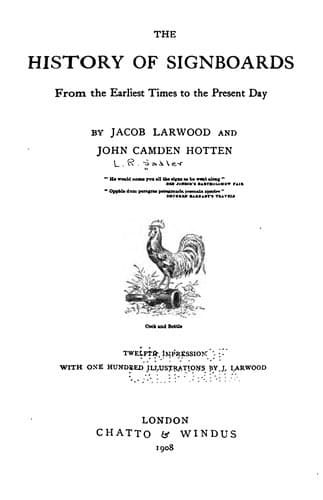
The History of Signboards, from the Earliest times to the Present DayHotten, John Camden
History
The History of Signboards, from the Earliest times to the Present Day
Hotten, John Camden
Inn signs -- England -- History; Signs and signboards -- History
The DUKE OF ALBEMARLE figured on numberless signboards after the
Restoration; but at the same period, there existed still older signs, on
which his grace was simply called Monck; as for instance, that hung out
by “Will. Kidd, suttler to the Guard at St James’s,”[68] which was the
MONCK’S HEAD. Kidd had probably followed the army in many a campaign in
former years, and was much more accustomed to the name of General Monck
than that of his Grace the Duke of Albemarle. Of the Duke of Ormond
there is still one instance remaining in Longstreet, Tetbury,
Gloucester, under the name of the ORMOND’S HEAD. A very few Dukes of
Marlborough are also left. In the beginning of the eighteenth century,
the DUKE OF MARLBOROUGH’S HEAD in Fleet Street, was a tavern used for
purposes very similar to those which we are accustomed now-a-days to
behold at the St James’ and the Egyptian Halls. Among the Bagford Bills,
and in the newspapers of the time, it is constantly mentioned as the
place where something wonderful or amusing was to be seen--panoramas,
dioramas, moving pictures, marionnettes, curious pieces of mechanism,
&c., &c.[69]
The LORD CRAVEN was once a very popular sign in London. It occurs
amongst the trades tokens of Bishopsgate Street Without, and even at
present there is a CRAVEN HEAD and two CRAVEN ARMS in London. These
signs were in honour of William Craven, eldest son of Sir William
Craven, knt., (Sheriff of London _temp._ Queen Elizabeth.) This nobleman
passed the greater part of his life abroad, serving the Protestant cause
in Holland and in Germany. During the Civil War, he at various times
gave pecuniary assistance to King Charles II., who at the Restoration
created him Viscount Craven of Uffington, &c. He is said to have been
privately married to Elizabeth, daughter of James I., the Queen of
Bohemia. He died, April 19, 1697. Though his public and military career
had certainly been brilliant, yet he owed his popularity probably more
to his civic virtues, shewn during the plague period, when he and
General Monck were almost the only men of rank that remained in town to
keep order. He even erected a pesthouse at his own expense in Pesthouse
Field, Carnaby Market, (now Marshall Street, Golden Square.) His
assistance during the frequent London fires, also tended to make him a
favourite with the Londoners.
Public-domain text, read in full here on John Shaqi.
Reviews
Reviews
No reviews yet
Be the first to share your thoughts on this work.
Elsewhere in the archive
Join the Discussion
Join the discussion
Sign in to leave a comment or review.
Sign InorCreate an account