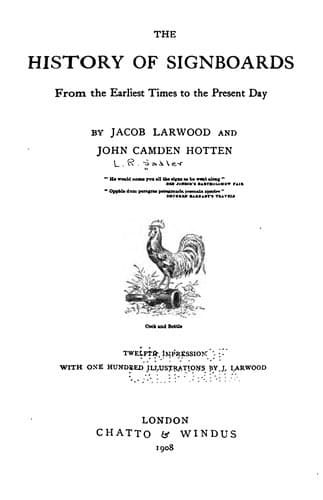
The History of Signboards, from the Earliest times to the Present DayHotten, John Camden
History
The History of Signboards, from the Earliest times to the Present Day
Hotten, John Camden
Inn signs -- England -- History; Signs and signboards -- History
There exists a curious alehouse picture, called the THREE JOHNS, in
Little Park Street, Westminster, and in White Lion Street, Pentonville.
The same sign, many years ago, might have been seen in Bennett Street,
near Queen Square, in the former locality. It represented an oblong
table, with John Wilkes in the middle, the Rev. John Horne Tooke at one
end, and Sir John Glynn (sergeant-at-law) at the other. There is a
mezzotinto print of this picture (or the sign may be from the print)
drawn and engraved by Richard Houston, 1769. John Wilkes, on whom the
popular gratitude for writing the Earl of Bute out of power conferred
many a signboard, still survives in a few spots. In a small
Staffordshire town called Leek-with-Lowe, there is a stanch re-publican,
who to this day keeps the WILKES’-HEAD as his sign, whilst another one
occurs in Bridges Street, St Ives. SIR FRANCIS BURDETT is also far from
forgotten, and may still be seen “hung in effigy” at Castlegate,
Berwick, in Nottingham, and in a few other places.
In 1683, we find SIR EDMUNDBURY GODFREY on the picture-board of Langley
Curtis, a bookseller near Fleetbridge. Being the martyr of a party, he
undoubtedly for a while must have been a popular sign. LORD ANGLESEY
was, in 1679, adopted by an inn in Drury Lane. This, we suppose, was
Arthur, second Viscount Valentia, son of Sir Thomas Annesley, (Lord
Mountmorris,) and elevated to the British peerage by the title of Earl
of Anglesey in 1661; he died in 1686. One of the acts which probably
contributed most to his popularity was that he, with the Lord Cavendish,
Mr Howard, Dr Tillotson, Dr Burnet, and a few others, appeared to
vindicate Lord Russell in the face of the court, and gave testimony to
the good life and conversation of the prisoner.
The bulky figure of Paracelsus, or, as he called himself, Philippus
Aureolus Theophrastus Paracelsus _Bombastus_ von Hohenheim, used
formerly to be a constant apothecaries’ symbol. From an advertisement in
the _London Gazette_, July 22-26, 1680, about a stolen horse “with a
sowre head,” we gather that there was at that time a sign of PARACELSUS
in Old Fish Street. Information about the horse with “the sowre head”
would also be received at a house in Lambeth, with no less a dignitary
for its sign than the BISHOP OF CANTERBURY, his grace having been thus
honoured from a neighbourly feeling.
Doctor Butler, (_ob._ 1617,) physician to James I., and, according to
Fuller, “the Æsculapius of that age,” invented a kind of medicated ale,
called Dr Butler’s ale, “which, if not now, (1784,) was, a few years
ago, sold at certain houses that had the BUTLER’S HEAD for a sign.”[75]
One of the last remaining Butler’s Heads was in a court leading from
Basinghall into Coleman Street.
[Illustration: PLATE V.
SPINNING SOW.
(France, 1520.)
TWO STORKS.
(Antwerp, 1639.)
THE COMPLETE ANGLER.
(Banks’s Bills, 1780.)
HELP ME THROUGH THIS WORLD.
(Banks’s Bills, 1812.)
CROOKED BILLET.
(Harleian Collection, 1710.)]
Public-domain text, read in full here on John Shaqi.
Reviews
Reviews
No reviews yet
Be the first to share your thoughts on this work.
Elsewhere in the archive
Join the Discussion
Join the discussion
Sign in to leave a comment or review.
Sign InorCreate an account