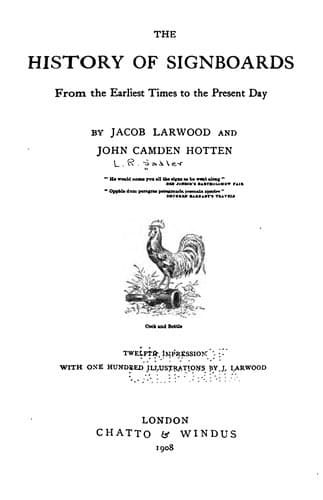
The History of Signboards, from the Earliest times to the Present DayHotten, John Camden
History
The History of Signboards, from the Earliest times to the Present Day
Hotten, John Camden
Inn signs -- England -- History; Signs and signboards -- History
That singularly successful quack, Lilly, though he ought not to be
placed in such good company as the king’s physician, was also a constant
sign, in the last century, at the door of sham doctors and astrologers.
Not unfrequently they combined the BALLS (a favourite sign of the
quacks) with Lilly’s head, as the BLACK BALL AND LILLYHEAD, the sign of
Thomas Saffold, “an approved and licensed physician and student in
astrology: he hath practised astronomy for twenty-four years, and hath
had the Bishop of London’s licence to practise physick ever since the
4th day of September 1674, and hath, he thanks God for it, great
experience and wonderful success in those arts.” He promised to perform
the usual _tours de force_.
----“foretell what s’ever was
By consequence to come to pass;
As death of great men, alterations,
Diseases, battles, inundations,
Or search’d a planet’s house to know
Who broke and robb’d a house below.
Examined Venus and the Moon
To find who stole a silver spoon.”
_Butler’s Hudibras._
This address was “at the Black Ball and Lilly Head, next door to the
Feather shops that are within Blackfriars gateway, which is over against
Ludgate Church, just by Ludgate in London.”[76]
Classic authors also have come in for their share of signboard
popularity in this country, which, at the time they flourished, was
about as little civilized as the Sandwich Islands in the days of Captain
Cook. These signs were set up by booksellers; thus HOMER’S HEAD was, in
1735, the sign of Lawton Gilliver, against St Dunstan’s Church,
publisher of some of Pope’s works, and in 1761, of J. Walker at Charing
Cross. Cicero, under the name of TULLY’S HEAD, hung at the door of
Robert Dodsley, a famous bookseller in Pall Mall. In a newspaper of
1756, appeared some verses “on Tully’s head in Pall Mall, by the Rev. Mr
G----s, of which the following are the first and the last stanzas:--
“Where Tully’s bust and honour’d name
Point out the venal page,
There Dodsley consecrates to fame
The classics of his age.
* * * * *
Persist to grace this humble post,
Be Tully’s head the sign,
Till future booksellers shall boast
To sell their tomes at thine.”
About the same time, the favourite Tully’s Head was also the sign of T.
Becket, and P. A. de Hondt, booksellers in the Strand, near Surrey
Street. HORACE’S HEAD graced the shop of J. White in Fleet Street,
publisher of several of Joseph Strutt’s antiquarian works; and VIRGIL’S
HEAD of Abraham van den Hoeck and George Richmond, opposite Exeter
Change in the Strand, in the middle of the last century. Of SENECA’S
HEAD two instances occur, J. Round in Exchange Alley in 1711, and ----
Varenne, near Somerset House, in the Strand, at the same period.
Public-domain text, read in full here on John Shaqi.
Reviews
Reviews
No reviews yet
Be the first to share your thoughts on this work.
Elsewhere in the archive
Join the Discussion
Join the discussion
Sign in to leave a comment or review.
Sign InorCreate an account