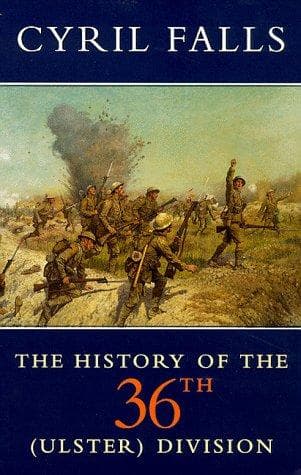
The History of the 36th (Ulster) DivisionFalls, Cyril
History
The History of the 36th (Ulster) Division
Falls, Cyril
Great Britain. Army. Division, 36th; World War, 1914-1918 -- Regimental histories -- Great Britain
General Nugent for a time contemplated a second attack with a
new barrage, to take at least the Green Line. The reports of
Brigadiers and Staff Officers visiting the line in the afternoon
made it clear that the troops were in no fit state for any such
attempt. Disorganization was still considerable; a high proportion
of officers and N.C.O.'s had fallen, and the men were utterly
exhausted. Moreover, neither the 108th nor the 109th Brigade could
have mustered five hundred men for a new attack. General Nugent
accordingly decided against this course, and instead ordered the
relief of the two attacking Brigades by the 107th that night. This
was carried out in circumstances of great difficulty, some platoons
not quitting the front line till after five o'clock next morning. The
weary remnants were moved straight back by 'bus to Winnizeele, and
that night a Brigade of the 61st Division relieved the 107th Brigade
in the line.
It is impossible to arrive at the exact casualties during the hours
of the actual assault. Between 6 a.m. on the 16th and 9 a.m. on
the 18th, however, there passed through the Divisional Dressing
Stations 58 officers and 1,278 other ranks, wounded or gassed. These
casualties do not include those of the attached artillery. They are
very high if the depleted state of the infantry prior to the attack
be taken into consideration. But they are almost insignificant if
compared with the total casualties suffered in the holding of the
line in the Salient, from August the 2nd to the 18th. In that period
the 36th Division lost 144 officers and 3,441 other ranks killed,
wounded, or missing. That is to say, it had more than two thousand
casualties ere launched to the attack. Two other commanding officers,
besides Colonels Somerville and Maxwell, were among the casualties.
Colonel A. C. Pratt, 11th Inniskillings, had been killed at the
entrance to Wieltje dug-outs early on the morning of the 16th, while
Colonel Macrory, 10th Inniskillings, had been severely wounded a
few days earlier. The difficulties of evacuating wounded during
the action were extraordinary. Stretcher cases had to be brought
by hand at least two thousand yards, and it took eight men to each
stretcher. There were 433 stretcher-bearers, of whom rather more than
half were R.A.M.C., the remainder being men of a Tunnelling Company
and the Divisional Salvage section. Among many who displayed great
bravery in the work of evacuating wounded under heavy shell-fire
was the Assistant Chaplain-General of the Division, the Rev. F. J.
Halahan, M.C., who by precept and personal example encouraged the
stretcher-bearers to new efforts. Search parties, sent out after
dark, brought in about a hundred wounded men from in front of our
line. The conduct of the medical officers with the battalions,
tending their wounded under the very heavy shell-fire that was
maintained throughout upon the Black Line, was beyond praise. Captain
Gavin, R.A.M.C., attached to the 14th Rifles, did splendid work at
Public-domain text, read in full here on John Shaqi.
Reviews
Reviews
No reviews yet
Be the first to share your thoughts on this work.
Elsewhere in the archive
Join the Discussion
Join the discussion
Sign in to leave a comment or review.
Sign InorCreate an account