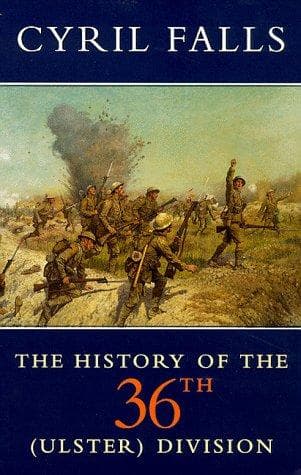
The History of the 36th (Ulster) DivisionFalls, Cyril
History
The History of the 36th (Ulster) Division
Falls, Cyril
Great Britain. Army. Division, 36th; World War, 1914-1918 -- Regimental histories -- Great Britain
Among other offensive methods employed must be recorded a new horror
of war, the Livens projector, which the troops of the 36th Division
now saw for the first time. It was simply a large steel drum filled
with lethal gas, under compression, fired from a short tube. Its
range was upwards of two thousand yards. Six hundred of these mortars
were dug in at the bend of the Canal, and on the night of the 14th
of September fired into Havrincourt. It was definitely established
by the evidence of prisoners captured the following month that the
losses in the village were very heavy. The battalion which held it
had to be relieved that night. In two dug-outs alone twenty men were
killed by the gas.
The artillery also was active. The ammunition allotment was high.
It was, indeed, the huge increase in the supply of 18-pounder
ammunition that had made really "quiet bits" almost unknown upon
the British front. For when the British had ammunition they fired
it off. The French, on the other hand, on a quiet front, preferred
to live quiet lives. The IV. Corps ordered that two-thirds of the
allotment should be expended at night, in harassing fire upon roads.
As most of our batteries had little flash-cover, such shooting
betrayed gun positions. Recourse was therefore had to single guns for
night-firing, pushed forward at dusk and withdrawn before dawn. Some
of these forward guns had an unpleasant reception. One was destroyed
by accurate enemy fire. The Germans, for their part, paid greater
attention to our batteries than to our trenches. Their favourite
method, which the 36th Division had experienced in Flanders, was
a deliberate "shooting-up" of a single battery, beginning with
aeroplane observation, and continued by the aid of high shrapnel
bursts, which could be "spotted," for five or six hours at the rate
of about a round a minute. These bombardments did some damage and
caused some loss to the gunners, but the latter had more than once
the satisfaction of drawing fire upon dummy or abandoned positions,
while those in use went scatheless.
Public-domain text, read in full here on John Shaqi.
Reviews
Reviews
No reviews yet
Be the first to share your thoughts on this work.
Elsewhere in the archive
Join the Discussion
Join the discussion
Sign in to leave a comment or review.
Sign InorCreate an account