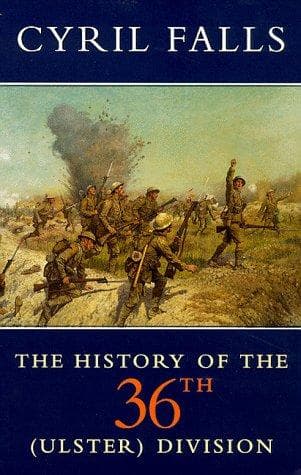
The History of the 36th (Ulster) DivisionFalls, Cyril
History
The History of the 36th (Ulster) Division
Falls, Cyril
Great Britain. Army. Division, 36th; World War, 1914-1918 -- Regimental histories -- Great Britain
For the assault upon the spoil heap a battery of four-inch Stokes
mortars to fire "thermit" shell, which had been used with effect
at Messines, had been procured. For four minutes these mortars and
the covering artillery bombarded its south-west side. Then the
10th Inniskillings charged home and took it. There was no serious
fighting here. The effect of the "thermit" shell was terrific
morally. The defenders ran northwards up the trenches. A number were,
however, killed by machine-gun fire, while seventy prisoners and two
machine-guns were taken. The prisoners belonged to the 20th Landwehr
Division, which had not been identified, and had come into line but
two days before. This discovery was of good augury for the attack,
since by this period of the war Landwehr troops were not of high
quality.
The necessary point of entry into the German trenches having been
won, the 10th Inniskillings pushed up them according to plan,
behind their barrage. A second doorway was forced when, directly
the barrage lifted from it, a company of the 14th Rifles, attached
to the 10th Inniskillings, entered the communication trench on the
Demicourt-Flesquières Road, fifteen hundred yards north of the first
one. The clearing of the captured trenches was carried out most
systematically. The leading platoons dropped a man at the entrance to
each deep dug-out, to be picked up by the fourth section following in
rear, which was allotted the duty of "mopping up." As each dug-out
was cleared, a notice-board was set up at entrance bearing the
significant inscription "Mopped"! When the leading platoon exhausted
its men, another moved through to the front, the first reorganizing
behind it. A single flag with the battalion colours was carried by
the leading platoon, and never displayed save at the head of the
advance. The 10th Inniskillings reached their objective just north of
the Demicourt-Flesquières Road at 9-30 a.m., or a few minutes behind
schedule time. This, however, was of no significance, since the
line now held was part of the general second objective of the whole
attack, and there was a pause upon it of twenty-five minutes. The
second objective had been reached upon the whole front, save only at
Flesquières.
Public-domain text, read in full here on John Shaqi.
Reviews
Reviews
No reviews yet
Be the first to share your thoughts on this work.
Elsewhere in the archive
Join the Discussion
Join the discussion
Sign in to leave a comment or review.
Sign InorCreate an account