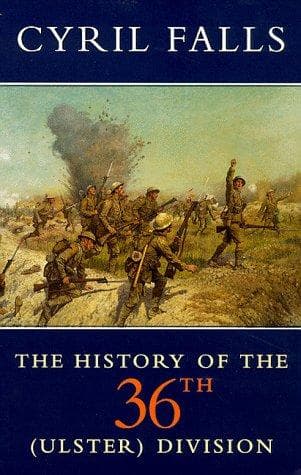
The History of the 36th (Ulster) DivisionFalls, Cyril
History
The History of the 36th (Ulster) Division
Falls, Cyril
Great Britain. Army. Division, 36th; World War, 1914-1918 -- Regimental histories -- Great Britain
On the front of the 108th Brigade there were fewer alarums and
excursions. In the Couillet Valley its troops had even room for
movement, the Germans contenting themselves with the establishment
of posts in the sunken roads leading from Marcoing. Two prisoners
were captured by the 2nd Rifles, and one by the 9th Irish Fusiliers.
One post on the higher ground, at the very nose of the salient, was
driven in by the enemy, but promptly re-established. One of the
German prisoners reported that an attack was to be launched at dawn
on the 14th. All troops and reserves "stood to," and an hour before
dawn a great bombardment was opened by all the artillery on the III.
Corps front. If attack were contemplated it did not develop. Until
two days before its final relief the Division's front was covered by
the 17th Artillery Brigade of the 6th Division, and three Army Field
Artillery Brigades, under the command of General Brock. On the 14th
the personnel of its own Artillery came in, taking over the guns _in
situ_ of two of these Brigades.
Welsh Ridge was safe now from anything but a "full dress" attack.
But that was precisely what appeared to be coming. The Germans were
plainly in aggressive mood. Their aeroplanes swept continually
down upon our front-line trenches, firing upon the men in them.
Areas in rear, about Metz especially, were bombed night and day.
Their artillery was very active. Havrincourt Wood was rendered
uninhabitable by its constant shelling. And it was increasingly plain
that the infantry and machine-gunners of the 36th Division were in no
fit state to withstand a new offensive in force.
Never since it landed in France had the troops of the 36th Division
been reduced to a physical ebb so low. The men became indescribably
dirty; lungs, throats, and hearts were affected. High as were battle
casualties, the sick wastage was higher still, which had not been the
case even at Ypres in August, because then the weather, if wet, was
warm. The troops had, in fact, been exposed to three weeks of winter
in the open, with almost continuous fighting, while it is doubtful if
those of the 36th Division had fully recovered from the effects of
the Ypres episode, three months earlier. The great captains of old
times, who decided that long spells of open warfare in winter were
impossible, were not fools. Man born of woman cannot withstand for
long that combined strain and exposure without appalling physical and
moral deterioration. Morally the infantry had survived far better
than the authority which left them in line had right to expect. The
men kept surprisingly good hearts. Walking round these much-harassed
outposts one was still greeted with a grin when one inquired how many
"pine-apples" had come over in the last twenty-four hours from the
German blocks a little further down the trenches. But physically they
were wrecks. They were living on their nerves.
Public-domain text, read in full here on John Shaqi.
Reviews
Reviews
No reviews yet
Be the first to share your thoughts on this work.
Elsewhere in the archive
Join the Discussion
Join the discussion
Sign in to leave a comment or review.
Sign InorCreate an account