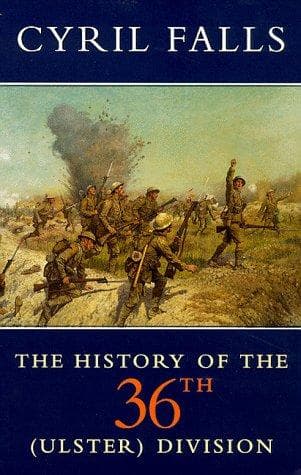
The History of the 36th (Ulster) DivisionFalls, Cyril
History
The History of the 36th (Ulster) Division
Falls, Cyril
Great Britain. Army. Division, 36th; World War, 1914-1918 -- Regimental histories -- Great Britain
The troops of the 36th Division halted at mid-day in the
neighbourhood of Avricourt, where they had a few hours' rest. They
then received orders to resume their march. The 107th Brigade moved
back to Guerbigny, on the banks of the Avre; the 108th Brigade to
Erches, a mile north of that village; the 109th Brigade to Guerbigny
and Warsy. Troops arrived between midnight and two o'clock, and, for
the first time since the beginning of the attack, had a continuous
sleep of at least six hours in comfortable billets. The 9th Irish
Fusiliers, however, coming straight through from the neighbourhood of
Guiscard, a distance of upwards of thirty miles, did not arrive till
8 a.m. General Nugent established his headquarters in Warsy.
The spectacle of the infantry upon that march was one that would
have aroused compassion in the most war-hardened breast. Men's
faces were deeply marked by overwhelming fatigue and lack of sleep.
Some moved in a sort of trance, stumbling forward oblivious to
their surroundings. In some cases their boots had given out. Many
company officers, in the course of the last few miles, dispensed
with the regulation halts, because they found it almost impossible
to get their men on their feet again after them. They lay like logs,
and had to be violently shaken before they could be recalled to
consciousness. Fortunately more 'buses had been sent for the 61st
Brigade than that scanty remnant required, and a few were able to
assist in moving back the men absolutely unable to walk.
There were other sights upon that line of march perhaps even more
moving. The men in this evil case were, after all, soldiers,
undergoing such experiences as many soldiers have undergone in many
great retreats. The spectacle of the civilians, turning out in haste
from their homes, was often heartrending. Their big wains would
be piled high with their household possessions, with perhaps the
old grandmother of the family holding its youngest baby, perched
perilously on top. Mile after mile, at the cart-tail, or driving
cattle that became mixed up with the British transport, the children
trudged in the rain. It was only the rich and comparatively fortunate
that had horsed transport. The poorer struggled along with the most
valuable of their things upon handcarts. The present writer remembers
seeing a woman carried out on a bed and put on to a farm-cart. He
was told she had given birth to a child two hours earlier. A little
later he came upon an old woman pushing her paralyzed husband in
a wheelbarrow. Let those who desire to realize what effort this
requires for a woman of sixty, try wheeling a heavy man in a
wheelbarrow even a hundred yards. For these room was found in a
British lorry at the next village, but there were many cases where
such relief was impossible.
Public-domain text, read in full here on John Shaqi.
Reviews
Reviews
No reviews yet
Be the first to share your thoughts on this work.
Elsewhere in the archive
Join the Discussion
Join the discussion
Sign in to leave a comment or review.
Sign InorCreate an account