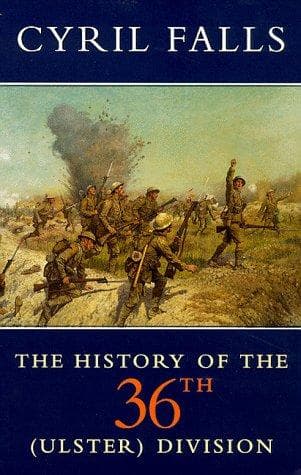
The History of the 36th (Ulster) DivisionFalls, Cyril
History
The History of the 36th (Ulster) Division
Falls, Cyril
Great Britain. Army. Division, 36th; World War, 1914-1918 -- Regimental histories -- Great Britain
The troops had now been in position for six hours; six hours of time
the value of which no standard can measure. When their physical
state is considered, the steadiness they showed on this occasion is
equal to any of their achievements through the week that had passed.
Every German attempt to advance was frustrated by their fire. No
artillery was supporting them. Even a single battery of 18-pounders
would have been of great service, and would have had many splendid
targets round Andechy. The Germans, for their part, were now
heavily bombarding the village of Erches, which the 108th Brigade
Headquarters were obliged to quit, moving into the open fields behind
it.
At dusk the enemy launched an attack in strength upon Erches,
preceded by a bombardment. By eight o'clock he was in the village.
The 108th Brigade Headquarters was attacked at close quarters, and
General Griffith slightly wounded in the hand fighting his way
clear of the German patrols. Colonel Place, the G.S.O.1 of the
Division, going up from Guerbigny in a car, with Colonel Furnell of
the 1st Irish Fusiliers, and Major Brew of the 9th, to ascertain
the position, ran into a party of the enemy. A bullet stopped the
engine of the car. Colonel Place jumped out, but before he could
draw his pistol from under his coat was hit in the leg, and fell in
the roadway. Instantly a German sprang upon him and stabbed at him
with his bayonet. Fortunately for Colonel Place, the thickness of
his "British Warm" saved him. The little party had no alternative to
surrender. The car was subsequently recovered, towed back, and served
the Division well in after days.
Colonel Place had been G.S.O.1 of the 36th Division for more than
two years. As a staff officer he was far more than merely able and
efficient. His sympathy and imagination enabled him to grasp all
points of view, and to understand those which were different to
his own. He never seemed to require, as do so many men engaged on
difficult tasks, an hour free from interruption, but could switch
his mind on to each new problem presented to him, and return to his
own where he had left it. His loss in this unlucky fashion was much
regretted.
Lieutenant Cumming, whose reconnaissance on the 21st has been
mentioned, led a patrol of six men into Guerbigny, to see if the
enemy had yet entered it. They had not, but on his way the patrol was
attacked by a German patrol of five. As a result of the fight every
single German was killed.
Public-domain text, read in full here on John Shaqi.
Reviews
Reviews
No reviews yet
Be the first to share your thoughts on this work.
Elsewhere in the archive
Join the Discussion
Join the discussion
Sign in to leave a comment or review.
Sign InorCreate an account