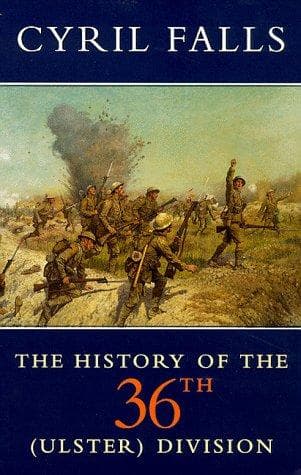
The History of the 36th (Ulster) DivisionFalls, Cyril
History
The History of the 36th (Ulster) Division
Falls, Cyril
Great Britain. Army. Division, 36th; World War, 1914-1918 -- Regimental histories -- Great Britain
The Germans, it must be explained, appeared to be holding the
opposite bank of the Lys in some strength. At several points they
had put up wire fences to defend it. Opposite Oyghem, near the 36th
Division's left flank, was one very large moated farm, round which
they had dug a trench. The plan was that one battalion of the 109th
Brigade should be ferried across at dusk on the 19th, should push
forward to the main Courtrai-Ghent Road, from east of Beveren to
Dries, on a front of a thousand yards. That accomplished, a second
battalion was to cross, to form flank from the Oyghem-Desselghem
Road to the left of the leading battalion. Two machine-gun companies
were allotted to the operation, "B" to fire a barrage, "C" with
its sections attached to the battalions of the 109th Brigade. The
original intention had been for the 121st and 150th Field Companies
to effect crossings for the infantry opposite both Oyghem and
Beveren. A daring daylight reconnaissance of the river-bank by
Lieutenant W. Brunyate, of the latter company, caused the Oyghem
crossing to be abandoned, and the construction of a bridge at that
point postponed till the first part of the programme was complete.
The bank here was very steep, was heavily wired, and commanded by
machine-guns. The farm of which mention has been made would have been
in itself a formidable obstacle. Three bridging wagons with full
bridging equipment had been brought up the previous night and hidden
in farm buildings beside the river bank, north-west of Beveren, by
the 121st Field Company. The pontoons of the 150th Field Company were
hidden slightly further north.
At dusk two pontoons were launched, and at 7-25 p.m. the passage of
the 9th Inniskillings began. Two trips were actually made before
the enemy fired a shot; then machine-gun fire burst out, followed a
little later by that of artillery. Nevertheless, by 8 p.m. the whole
battalion and its attached section of machine-guns[62] were across,
with one casualty only. Hastily in the darkness the battalion formed
up. Then the British barrage dropped, and it began its advance over
open country. The night was cloud-veiled, but the full moon was of
great assistance to subsequent operations. Capturing such machine-gun
detachments as did not fly, the 9th Inniskillings worked its way
steadily forward, and crossed the Beveren-Dries Road, four hundred
yards short of its objective, the main road from Courtrai to Ghent.
Almost immediately afterwards, however, it was held up by heavy
machine-gun fire. It had not accomplished quite all that had been
hoped, but it had done enough. The still more complicated task of
bringing across a second battalion to guard the left flank remained.
Public-domain text, read in full here on John Shaqi.
Reviews
Reviews
No reviews yet
Be the first to share your thoughts on this work.
Elsewhere in the archive
Join the Discussion
Join the discussion
Sign in to leave a comment or review.
Sign InorCreate an account