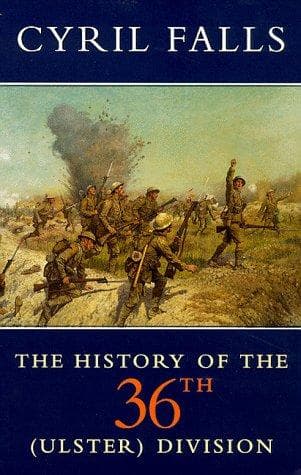
The History of the 36th (Ulster) DivisionFalls, Cyril
History
The History of the 36th (Ulster) Division
Falls, Cyril
Great Britain. Army. Division, 36th; World War, 1914-1918 -- Regimental histories -- Great Britain
On November the 2nd, Divisional Headquarters and the 107th Brigade
moved to Mouscron, practically a suburb of Tourcoing, but on the
other side of the frontier, in Belgium. Training and reorganization
were carried out. Ranks filled up, and the troops, in splendid
billets, speedily threw off their fatigue. Another turn in the
line was still expected. But that was not required. If the 36th
Division was not actually "in at the death," it had afterwards the
satisfaction of knowing that the war was really won when it left
the firing-line. The very day after, October the 28th, the German
_communiqué_ was signed by the "Chief of the General Staff of the
Field Army"--Hindenburg--instead of the "First Quarter-Master
General"--Ludendorff. The meaning of that was instantly grasped.
Ludendorff, the great gambler, whose final throws had brought him so
near success, had resigned. A day later, and it was announced that
Austria had thrown up the sponge. On the 7th of November the German
_parlementaires_ passed through the French lines at Guise, on their
way to interview Marshal Foch. Then came the news of the Armistice.
It was celebrated by the troops in France without that wild hilarity,
wild almost to hysteria, that greeted it in London. Perhaps the man
who had been trudging forward, week by week, facing the machine-guns,
if in front, sniffing for gas, and, by night, listening anxiously for
the purr of the Gotha, if in rear, hardly realized that it was all
over. The men were, none the less, intensely happy. Everywhere they
were _fêted_ and acclaimed by the civilians whom they had freed from
four long years of bondage. Best of all, after years of discomfort
and exposure, they slept softly, undisturbed by the crash of bombs.
And so, as Lord Fisher afterwards put it, "at the eleventh hour of
the eleventh day of the eleventh month," the war came to its end.
[Illustration: Map VII.
The Final Advances, 1918.]
This History contains few of those Special Orders of the Day which,
long after the events that gave them birth, are inclined to appear
heavy, and sometimes fail to accord with present sentiment. That
of General Jacob has been quoted because it was under his fine
leadership that the men of the 36th Division marched to final
victory. It would not be fitting to conclude this chapter without
recalling that issued at the end of hostilities to all the Allied
Armies by the Marshal in supreme command, who inherits from his
teacher, the greatest soldier his country and the modern world ever
produced, the gift of making a few words majestic and ever-memorable.
Amidst our present discontents some of the glory of these words of
Marshal Foch may appear tarnished, but, like the words of Napoleon
to his troops in Egypt, they will endure, when immediate sorrows and
disappointments are forgotten, perhaps when the very causes for which
men laid down their lives by millions have become obscure.
"Officiers, sous-officiers, soldats des Armées Alliées.
Public-domain text, read in full here on John Shaqi.
Reviews
Reviews
No reviews yet
Be the first to share your thoughts on this work.
Elsewhere in the archive
Join the Discussion
Join the discussion
Sign in to leave a comment or review.
Sign InorCreate an account