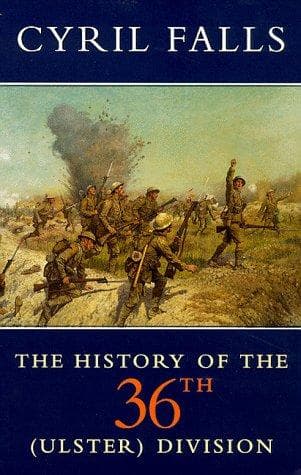
The History of the 36th (Ulster) DivisionFalls, Cyril
History
The History of the 36th (Ulster) Division
Falls, Cyril
Great Britain. Army. Division, 36th; World War, 1914-1918 -- Regimental histories -- Great Britain
Two hours later a raid was carried out in this sector by a party sent
up by the 13th Rifles. The men, now at a pitch of excitement and
enthusiasm that rendered them resistless opponents in hand-to-hand
fighting, swarmed into the battered German trenches, shooting right
and left, and bombing dug-outs. They returned with one German officer
and twelve other ranks as prisoners, the first captured by the 36th
Division. Their own casualties were six killed and nine wounded,
suffered for the most part in the Sunken Road, where, like the 9th
Inniskillings, they had to lie for some time ere it was possible to
return to their trenches. Captain Johnston, the leader of the raid,
brought in all his casualties, as well as his prisoners. He was to
fall five days later in the greater venture. The prisoners denied
knowledge of our gas, nor did their respirators smell of it. It was
occasionally the experience of the Division that the British gas
services rated too highly the effects of their devices.
On the 27th, "X" day, it rained in sheets, and "Y" day was little
better. It was accordingly decided by the Higher Command to postpone
the attack for two days. This necessitated a postponement of the
assembly also. Instead, inter-brigade reliefs were carried out in
the trenches to give some rest to the troops that had endured the
early hammering. Their rest, unfortunately, was in huts in Martinsart
Wood, huts that trembled and creaked to the terrific roar of siege
howitzers firing night and day beside them. Yet it was better than
that other wood across the river, which was the following day, now
"Y.1" day, visited by the heaviest bombardment yet seen. The trenches
were in a terrible state, and the men of the medium trench mortar
batteries, engaged in cutting the German wire, suffered more even
than the infantry, and earned the admiration of the latter by their
devotion to their task.
In all the circumstances it must be said that the total casualties
for the month of June, approximately seven hundred and fifty,
were not heavy. They included the results of a veritable calamity
that befell the 13th Rifles. On the evening of the 28th, "Y" day,
the battalion was relieving the 11th Rifles in Thiepval Wood,
and marching out of Martinsart by platoons at two hundred yards'
interval. As number 11 Platoon and battalion headquarters were about
to march out together a shell fell right in the midst of the party.
Fourteen were killed on the spot, and ten more died later. Almost all
the rest were wounded, including the second-in-command, Major R. P.
Maxwell, and the adjutant, Captain Wright. The confusion in the pitch
darkness, with scarce a man on his feet, was appalling. Fortunately a
platoon of the 11th Rifles, just relieved from the trenches, appeared
on the scene, and the street was speedily cleared. But the Germans
could have had far bigger hauls than this at "Lancashire Dump" on the
Albert-Hamel Road in Aveluy Wood any night they had chosen to shell
it.
Public-domain text, read in full here on John Shaqi.
Reviews
Reviews
No reviews yet
Be the first to share your thoughts on this work.
Join the Discussion
Join the discussion
Sign in to leave a comment or review.
Sign InorCreate an account