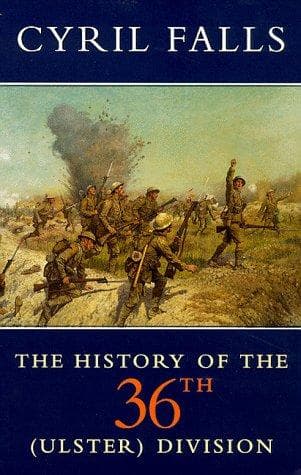
The History of the 36th (Ulster) DivisionFalls, Cyril
History
The History of the 36th (Ulster) Division
Falls, Cyril
Great Britain. Army. Division, 36th; World War, 1914-1918 -- Regimental histories -- Great Britain
This was the _rendezvous_ of a mass of transport immediately after
dusk, bringing up munitions and rations for the offensive. Large
stores of the latter were placed in specially constructed dug-outs
on the river bank. The work of the Divisional Train was here most
admirably organized by its commander, Colonel Bernard. So close
were the big convoys to the German trenches that extraordinary
precautions to avoid noise had to be taken. Wheels were bound with
straw and old motor tyres, steel chains replaced by leather straps,
boots, like those used in rolling a cricket ground, placed over the
horses' hoofs. And it was an amusing sight to see an A.S.C. driver
frantically clinging to the nose of some sociable horse that desired
to greet new acquaintances with a friendly neigh.
The reward of waiting came in a fine day on "Y.2" day, the 30th.
Divisional Headquarters moved up to their report centre on the
Englebelmer-Martinsart Road. At night the approach march took
place, and assaulting battalions returned to their positions in the
trenches. The assembly positions of the 107th Brigade (less 15th
Rifles) were in slit trenches in Aveluy Wood. The battalions marched
up by cross-country tracks, marked, one by red lanterns, the other by
green. The night was fine, and the artillery on either side rather
less active, though lachrymatory shell was falling in the wood.
In a curious complete lull that fell before dawn, men heard with
astonishment a nightingale burst into song, pouring out her bubbling
notes one upon the other, as though this had been still the pleasant
copse, deserted by man, but a kingdom of the birds, of two years gone.
The two days' postponement had had upon the men an effect contrary to
that which might have been attended. The extra strain of waiting was
more than counterbalanced by the coincidence of the date. For it was
upon July the 1st, the anniversary of the Boyne, that the sons of the
victors in that battle, after eight generations, fought this greater
fight. To them it had a very special significance. A stirring in
their blood bore witness to the silent call of their ancestors. There
seemed to them a predestination in the affair. They spoke of it as
they waited, during the final intensive bombardment, while the German
counter-barrage rained upon their trenches.
Public-domain text, read in full here on John Shaqi.
Reviews
Reviews
No reviews yet
Be the first to share your thoughts on this work.
Join the Discussion
Join the discussion
Sign in to leave a comment or review.
Sign InorCreate an account