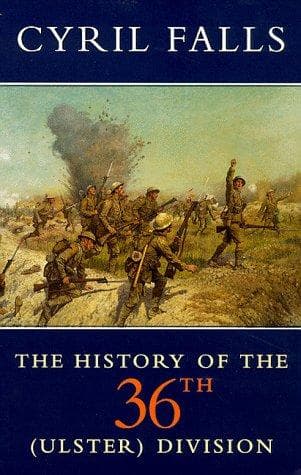
The History of the 36th (Ulster) DivisionFalls, Cyril
History
The History of the 36th (Ulster) Division
Falls, Cyril
Great Britain. Army. Division, 36th; World War, 1914-1918 -- Regimental histories -- Great Britain
It is the custom, kept throughout this History, to describe the
course of battles from the right hand to the left. If here it is
departed from, it is only because the action on the north side of
the Ancre was separate from the other and of lesser importance. Its
description, alas! will occupy small space enough. There was here in
"No Man's Land" a deep ravine, which the map contours show without
giving an idea of its abruptness. The first wave of the 9th Irish
Fusiliers reached this with little trouble, but those which followed
met with very heavy machine-gun fire, and suffered terrible loss.
Advancing at Zero with splendid dash, the survivors of a battalion
which Colonel Blacker's training had made one of the best in the
Division, swept through the enemy's front line trenches. One small
body of the right centre company in particular carried all before it,
and was last seen advancing upon Beaucourt Station. On the left the
12th Rifles had worse fortune. The wire round the German salient over
the hill-brow, less easy to observe, was less completely destroyed
than on the rest of the front. Many gaps were cut, but machine-guns
were trained upon them. Beaten back at the first rush, and having
lost the barrage, the remnants of the battalion were twice re-formed
by devoted officers under that withering hail, and twice again led
forward. It was of no avail. On their left the leading troops of the
next Division crossed the front line trenches, but were assailed from
the rear by machine-gunners emerging from dug-outs. At eight o'clock
the 36th Division was informed that the enemy had retaken his front
line. The attack north of the Ancre was a failure, though gallantry
every whit as great as that of the battalions on the left bank was
behind it.
Elsewhere, for all its losses, the attack was a complete success.
Every objective was reached. Had it been possible to attain the
same results all along the front, the day would have ended with the
greatest British victory of the war.
The leading waves, still moving as on parade, reached the German
front line trench and moved straight across it. They did not suffer
heavily. Hardly were they across, however, when the German barrage
fell upon "No Man's Land," upon the rear companies of the first
line battalions, and upon those of the second line. And immediately
the barrage left it, flanking machine-gun fire burst out from the
dominating position of Thiepval cemetery. The 11th Inniskillings and
14th Rifles, as they emerged from the wood, were literally mown
down, and "No Man's Land" became a ghastly spectacle of dead and
wounded. On the left of the line the 13th Rifles, under long-range
fire from the Beaucourt Redoubt across the river, suffered at this
stage most heavily of all. They had lost the bulk of their officers
ere ever they reached the German trenches. The Division on the right
was never able to clear Thiepval village, and it was that fact which
was responsible for the gravest losses of the 36th.
Public-domain text, read in full here on John Shaqi.
Reviews
Reviews
No reviews yet
Be the first to share your thoughts on this work.
Join the Discussion
Join the discussion
Sign in to leave a comment or review.
Sign InorCreate an account