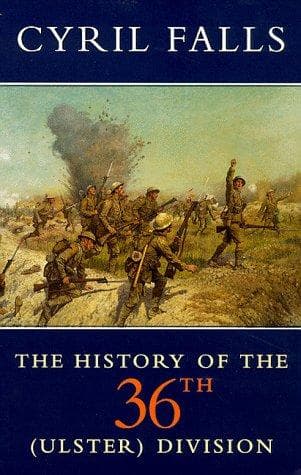
The History of the 36th (Ulster) DivisionFalls, Cyril
History
The History of the 36th (Ulster) Division
Falls, Cyril
Great Britain. Army. Division, 36th; World War, 1914-1918 -- Regimental histories -- Great Britain
Under this deadly punishment the men never hesitated. They went
straight forward across the first two lines, sending back the few
prisoners they took. The "B" line was to be reached at 7-48. Despite
the gaps in their ranks the first wave swept upon it at precisely
that moment. There was not much fighting here, but a large number of
prisoners was taken, the German infantry surrendering as our men came
upon them. The 15th Rifles, the supporting battalion of the 108th
Brigade's attack, had, however, to deal with some Germans who came up
out of unnoticed dug-outs after the leading battalions had crossed
the "A" lines, the bombing squads told off to clear the trenches
having been destroyed by machine-gun fire. On pressed the leading
waves. Never losing the barrage, they took the "C" line, including
the north-east corner of the Schwaben Redoubt, at 8-48. Even in
the trenches they suffered loss from the flanking machine-guns,
while movement from front to rear was now all but impossible. The
supporting battalions, or their survivors, were also upon their
objectives. Every man had done what he was set to do, or dropped in
his path. And, to the eternal credit of our artillery, no man appears
to have needed his wire-cutters.
Let us turn to the 107th Brigade, which had meanwhile advanced to the
"A" line. It had moved from Aveluy Wood and across the Ancre to the
western skirts of Thiepval Wood, almost at the bottom of the valley,
assembling at 6-30 about the track known as Speyside. It had an hour
to wait, shell after shell passing just over the heads of the troops
and bursting in the marshes beyond them. At Zero, led by the 10th
Rifles, it moved back east for a short distance, to reach the rides
which were its paths to the front line. Here the men could see the
troops of the Division on the right issuing from their trenches,
and each platoon, as it extended in "No Man's Land," disappearing
before the blast of machine-gun fire that met it. The ride used by
the 10th Rifles on the right had been denuded of its foliage by
the bombardments of several days, and was in view. The battalion
came under machine-gun fire from front, right, and right _rear_
simultaneously. The commanding officer, Colonel Bernard, was killed,
and casualties were high. The final passage had to be carried out by
rushes to the front line. The leading men could even see the German
machine-guns firing at them, so that it is easy to imagine what sort
of target they offered to those guns. Lewis guns were brought forward
to engage them, but their teams were destroyed. The other battalions
suffered considerably less, being screened in their rides, and
further from the Thiepval guns. Before ten o'clock, runners, with the
skill and devotion of their kind, had come back to report that the
"C" line had been reached. Eight minutes past, it may be remembered,
was the hour for the assault upon the "D" line.
Public-domain text, read in full here on John Shaqi.
Reviews
Reviews
No reviews yet
Be the first to share your thoughts on this work.
Join the Discussion
Join the discussion
Sign in to leave a comment or review.
Sign InorCreate an account